
Most agents are vague about what it costs to sell a house. There is a reason for that: one of
the biggest costs is their own fee, and the less you think about it, the better for them. We would rather just show you the lot. Here is every cost a WA seller actually faces, what each one roughly runs to, and the one big cost most people brace for that is not yours to pay at all.
First, the cost that is not yours: stamp duty
A lot of sellers worry about stamp duty. On the home you are selling, you can cross it straight off your list. In Western Australia, transfer duty (stamp duty) is paid by the buyer, not the seller.
It only becomes your cost when you buy your next home, and there it is one of the biggest upfront numbers you will face. On a $750,000 purchase the duty is around $29,740 at the time of writing, money you need on top of your deposit. It is genuinely one of the biggest things that holds people back from making their next move, so it is worth knowing your number before you start. You can work it out in seconds with our stamp duty calculator. Hold that $29,740 figure in mind. It matters again in a moment.
A quick aside: where stamp duty came from
It is worth knowing what that $29,740 actually is, because it puts the whole thing in perspective. Stamp duty began in colonial Australia as a small tax on legal documents, with some duties charged as low as one shilling. Property conveyance duty, though, was value-
based from the early colonial period, charged as a few shillings per hundred pounds of value, and it has grown from there into a major state revenue source.
Today, transfer duty raises WA roughly three billion dollars a year, somewhere around six to seven per cent of the entire state budget. That is why it has survived. Economists across the political spectrum regard stamp duty as one of the least efficient taxes in the country, because it punishes people for moving house, downsizing or relocating for work. But replacing several billion dollars of annual revenue is politically difficult, so the tax endures, and the bill keeps landing on the buyer at every sale.
None of which you can do anything about as a seller. But it is worth understanding that the single biggest cost in the whole transaction is not your agent. It is the tax the government collects from your buyer for processing the transfer.
The costs you do pay
1. Agent commission
There is no regulated or fixed commission rate in WA. It is negotiable and varies between agents, commonly somewhere around 2% to 3% of the sale price. Our rate is 2.5%, and it
includes GST.
On a $750,000 sale, that 2.5% works out to about $18,750. We will always show you that figure in dollars, not just a percentage, because you deserve to see exactly what you are
paying.
Now here is the part most agents will never point out. On that same $750,000 home, the buyer hands the WA government around $29,740 in stamp duty (the figure from above). The government collects roughly eleven thousand dollars more than your agent does, for processing the transfer, while your agent does the actual work of marketing the home, creating buyer competition, negotiating and getting it sold.
We do not raise that to make light of our fee. We raise it because a cost only means anything in context. The real question is never “what is the percentage.” It is “what do I walk away with, and who gets me the best result for it.” More on the right way to weigh commission in our guide to agent commissions, and the warning signs in.
2. Marketing and advertising
Marketing is usually charged separately from commission. The cost depends entirely on the campaign: professional photography, video, floorplans, portal listings on the major sites, a signboard, and any print or social advertising. A modest campaign might be a few hundred dollars; a full premium campaign on a higher-value home can run to several thousand.
Two honest points. First, ask any agent for the marketing cost in writing before you sign, not after. Second, with us you are not locked in: under our Best Service Guarantee you can cancel at any time and only pay for the marketing actually spent.
3. Settlement agent or conveyancer
You engage your own settlement agent to handle the legal transfer of the property. Conveyancing fees in Australia typically run somewhere between $500 and $2,000, depending on the complexity of the transaction. It is worth getting a quote up front so there are no surprises at settlement.
4. Mortgage discharge (if you have a loan)
If there is a mortgage on the property, it has to be discharged at settlement. That involves two small costs: a discharge administration fee charged by your lender (varies by lender, usually a few hundred dollars), and a fee to register the discharge of mortgage with Landgate (a set government fee, around $200 at the time of writing and indexed each July). Your lender and settlement agent will confirm the current amounts.
5. Rates and water adjustments
This one is not really a fee, but it affects what you walk away with. At settlement, council rates, water rates and any strata levies are adjusted between you and the buyer so each side pays only for the portion of the period they owned the home. You settle your share up to settlement day. It is an adjustment, not a charge, but it comes out of your proceeds.
Costs that apply only in some situations
- Capital gains tax. If the property is your family home (your main residence), it is generally exempt. CGT usually only applies if you are selling an investment or rental property. The rules are detailed and currently under review at a federal level, so this is a question for your accountant, not your agent. We are not tax advisers.
- Fixed-rate loan break costs. If your home loan is on a fixed rate and you break it early,
your lender may charge a break fee. Ask your lender before you list. - Presentation and repairs. Optional, but often worth it. What pays off and what does not is covered in should I renovate before selling.
So what does it actually add up to?
Here is an illustrative example on a $750,000 sale. Your numbers will differ, but it shows the
shape of it.
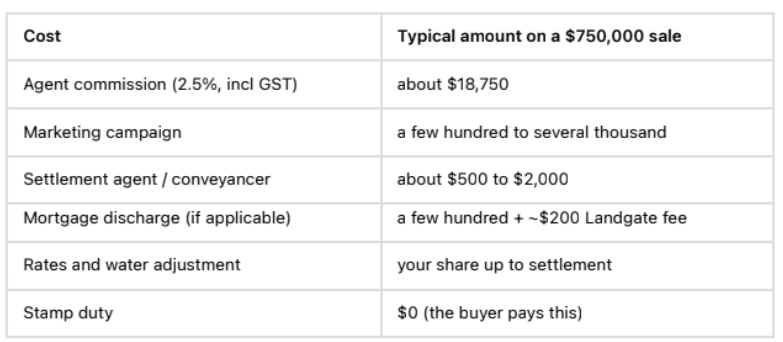
In a typical sale, the costs beyond commission come to a few thousand dollars. The single
largest cost, by a wide margin, is the commission, and the single largest variable is the sale
price the commission is charged on.
The honest point most agents will not make
The cost that actually matters is not any one line on that list. It is your net: the sale price
minus everything above.
A cheaper agent who sells your home for less can leave you thousands worse off than a better agent who gets a higher price. That is exactly what our Select Date Sale method is built to do. Instead of locking your home to a single fixed asking price, which can sit too high and go stale or too low and leave money on the table, it creates genuine competition
between qualified buyers to find the real top price. Two thousand dollars saved on a fee
means nothing if the same agent leaves twenty thousand on the table.
So by all means understand every cost. Then judge an agent on the number that counts,
what you are left with at the end, not the fee they advertise at the start. You can model your own numbers with our cost of selling calculator, and if you want the real figures for your home, that is what an appraisal is for.
Want the exact numbers for your home?
Book a free, no-obligation appraisal with Brendan Leahy. We will give you a realistic sale price for your property and suburb, walk you through the costs that actually apply to you, and show you your likely net in writing. Fifteen to thirty minutes, no pressure, whether you are selling soon or just want to know where you stand. Selling property across the Perth Hills and Foothills since 2002.
Truth. Strategy. Sold.
Book a free appraisal | 08 6254 6333 | Unit 1/198 Brookton Highway, Kelmscott WA 6111