

I will buy your home, but only if mine sells first.
That, in plain terms, is a subject to sale offer. And the question behind it is one of the most common we hear from homeowners across Bedfordale, Kelmscott, Roleystone, Mount Nasura, Mount Richon, Seville Grove and the wider Perth Hills and Foothills. Should we buy first, or sell first?
The honest answer is that it depends on you. Sometimes buying first is exactly the right move. Other times it turns into an expensive mistake. After personally helping people buy and sell more than 1,500 homes since 2002, I have seen both approaches work, and I have seen both go badly wrong. Here is how to tell which one you are looking at.
The short answer
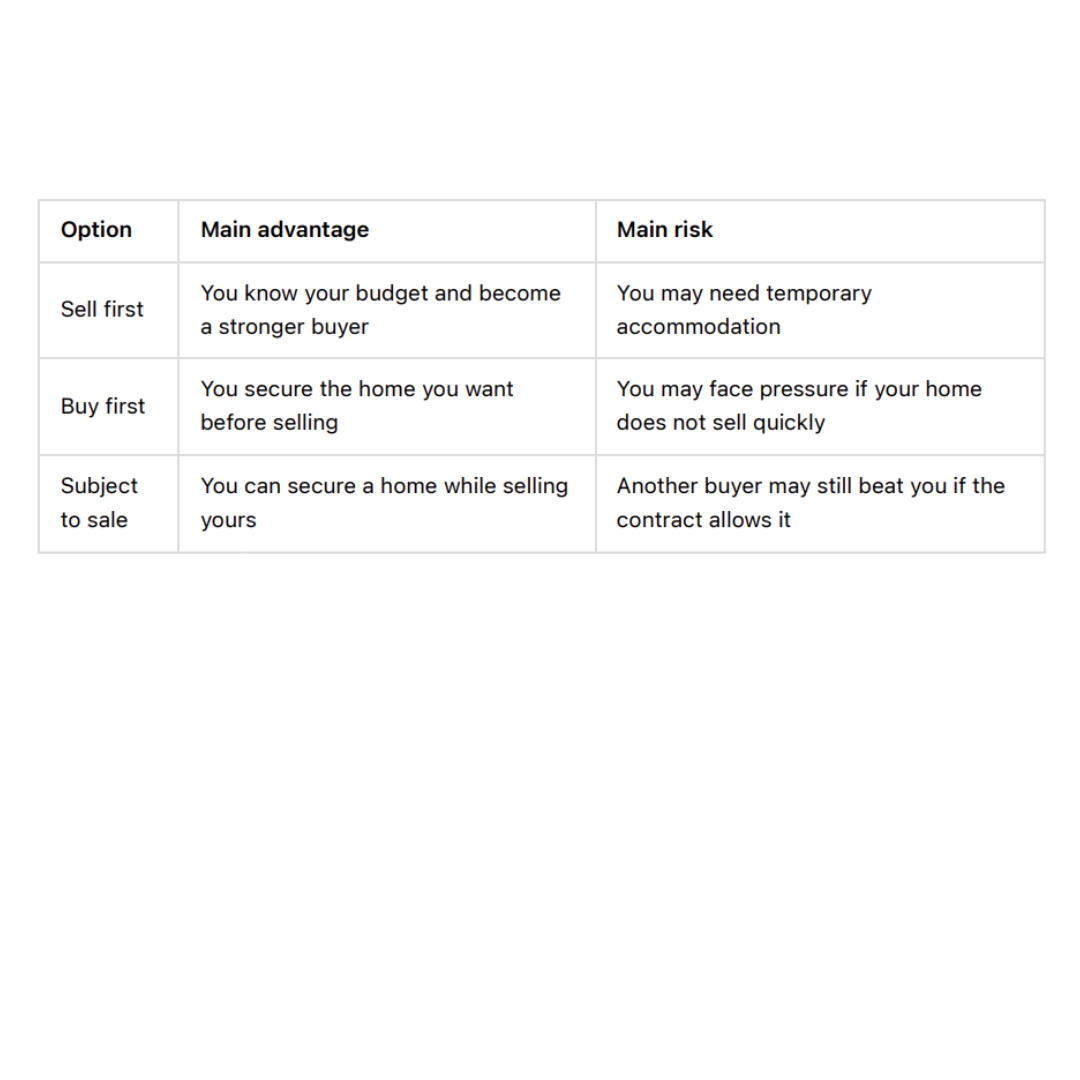
If your finances allow it, selling first usually puts you in the strongest position. You know exactly what your home has sold for. You know how much equity you have to work with. You know your budget with certainty. And you become a far stronger buyer, because you can make an offer without needing to sell anything first.
But life is not always that tidy. You may have found the home you really want. You may want to avoid moving twice. Or you may need the money from your current home to fund the next one. That is where a subject to sale offer comes in. The important thing is understanding exactly how it works before you sign anything.
Here is how the three paths compare at a glance:
What is a subject to sale offer?
A subject to sale offer lets you make an offer on another property that only becomes unconditional once your own home is sold. It can be an excellent solution. It also carries risks that a lot of people do not fully understand until they are in the middle of one.
The truth about subject to sale offers
These offers have picked up a bad reputation over the years, and in my experience it is mostly undeserved.
We do a lot of them, partly because of where we are. In the Hills there is a steady stream of people moving up from the flats into a bigger home on a bigger block, and most of them need to sell before they can buy. Across my own sales over more than two decades, and I have handled hundreds of these, roughly three in four of the buyers we work with are also sellers. That is a figure from my own records, not a market statistic, and it is simply how this part of the market moves.
So why do so many agents dislike them? Because they are more work. They need careful planning, constant communication, realistic pricing and someone actively managing two transactions instead of one. It is easier to deal with a straightforward cash or financeapproved buyer.
Here is the part I have never understood. A lot of agents will flatly refuse. No, we do not take subject sales on this home. I take them on, and I win a good number of listings precisely because the agent down the road would not. Helping people move is the job. For a lot of ffamilies, a subject to sale offer is simply the most practical way to make that move happen.
These offers can benefit sellers too
A buyer who has finally found the home they want, and who needs that exact property to make their move work, will sometimes pay a premium for the chance to buy it subject to the sale of their own home.
From the seller’s side, accepting a well prepared subject to sale offer is not always a disadvantage. If the buyer’s home is ready for sale, their price expectations are realistic and the deal is managed properly, the seller can come out ahead of where another buyer would have left them. Like most things in real estate, it is not about whether a subject to sale offer is good or bad. It is about how well it is structured.
A recent example from Bedfordale shows how this works in practice. I had clients who had found the home they wanted in Bedfordale but needed to sell their own place first. Rather than lock them into a 48-hour clause, I sat down with the sellers and walked them through the situation. They were happy to give my clients a few weeks without the 48-hour clause being invoked, so my clients had room to get their own home ready and onto the market properly.
They trusted the advice. We got the home ready. We launched it. Nine days later it was sold. Both sides came out happy: the sellers in Bedfordale got their result, and my clients secured the home they had moved for. No scramble, no two-business-day countdown hanging over anyone. Just a prepared buyer, a reasonable seller and an agent willing to negotiate the breathing room. Planning beat panic.
Pricing your home honestly is what makes it work
This is make or break, and it is where most failed subject to sale deals actually fail. When one falls over, it is almost always because the home was overpriced. It sits, it takes too long, sometimes it does not sell at all, and the buyer loses their dream home in the process. That is not the fault of the strategy. It is the fault of an agent who would not sit across from the seller and tell them the truth on price.
Remember why you are moving. A bigger block. Room for the kids. A workshop. A bigger kitchen for the cook in the family. Keep your eyes on that and the pricing decision gets a lot easier. Your goal here is not to set a suburb record. Your goal is to move.
Sometimes that means accepting that chasing your absolute top number is the expensive option, not the safe one. The seller who holds out for the last five or six per cent and loses the home they were moving for walks away worse off on both ends of the deal. Pricing to sell is how you protect the thing you actually came for.
Have your home ready to go, that day
One of the biggest mistakes buyers make is finding their dream home before getting their own property ready.
When you sign an offer with a subject to sale condition, the contract says your home goes on the market straight away, that day, at a set price. You do not get two or three weeks to get it ready. A week to declutter and tidy is fine. A full renovation to chase a higher price is not, and trying to squeeze one in is how people lose the home they were moving for.
So before you go looking, have it all lined up. Photography, marketing, presentation and price, ready to launch on day one. The faster your home hits the market, the better your chance of securing your next one.
Not ready to call yet? Before you do anything else, find out what your home is actually worth. It is free, it takes the guesswork out, and it is the one number every other decision depends on. Book a free appraisal
What is the 48-hour clause?
Many subject to sale contracts include a special condition commonly called the 48-hour clause. The name is misleading and the detail matters.
It lets the seller of the home you want keep marketing their property while your sale is pending. If they receive another offer they want to accept, usually an unconditional one, they must formally notify you. From that notice you get two business days, not a literal 48 hours, to do one of three things: waive your subject to sale condition and go unconditional, secure a contract on your own home, or arrange home to home finance (what used to be called bridging finance). If you cannot do any of those inside the two business days, the contract is cancelled, your deposit is returned to you, and the seller is free to accept the other offer.
Here is the part most agents will not tell you. That clause is negotiable. It is not automatic and it is not compulsory. When I represent the seller of a home a subject to sale buyer wants, and the offer in front of me is genuinely strong, I will often advise my seller to give that buyer three to four weeks with no 48-hour clause at all. The reasoning is simple. A buyer who was instead subject to finance would tie the property up for three to four weeks anyway. So a well prepared subject to sale buyer, with a realistically priced home ready to launch, is not necessarily exposed to the pressure people fear. That is my own practice, not a rule, and clause wording varies from contract to contract, so always read yours and get advice before you sign it.
Choosing the right agent matters more here than anywhere
If you are buying before selling, the agent you choose becomes the whole game. You are not just looking for someone to advertise your home. You need someone who will actually take a subject sale on, who will tell you the honest truth on price, who understands how these transactions work, who can communicate properly with the agent on the other side, who already has buyers to bring through your home, and who can keep two deals moving toward settlement at the same time. Experience is the difference.
Are there other options?
Depending on your financial position, alternatives can include:
- Negotiating a longer settlement so you have time to sell.
- A rent-back arrangement after settlement.
- Home to home (bridging) finance.
- Selling first, then negotiating a longer settlement on your purchase.
- Selling with a strategy built to create buyer competition, such as our Select Date Sale® method.
Every situation is different, which is exactly why strategy comes before paperwork.
So, should you buy before selling?
Sometimes. If you are financially comfortable and you understand the risks, it can work extremely well. If your finances are tight and your home is not ready for market, selling first is usually the safer road. There is no one size fits all answer. The right call depends on your equity, your borrowing capacity, the current market, the property you are chasing, and your appetite for risk.
Before you fall in love with another property, know three things:
- What your current home is worth.
- What it is realistically likely to sell for in today’s market.
- Which selling strategy gives you the best chance of success.
Those three answers remove most of the uncertainty. They are also completely free to find
out.
Thinking about your next move?
If you are planning a move anywhere across the Perth Hills or Foothills, we are happy to talk it through. We will explain the strategies open to you, give you an honest estimate of what your current home is worth, and help you decide whether buying before selling is the right move for you.
No pressure. Just straight advice backed by more than 1,500 personal home sales since 2002.
Call the office on 08 6254 6333, or get in touch with me directly.
Truth. Strategy. Sold.
Book your free appraisal today.
This article is general information based on more than two decades of selling property in the Perth Hills. It is not legal advice. Subject to sale and 48-hour clause wording varies from contract to contract. For your own situation, especially anything involving the contract terms, finance or settlement, speak to a licensed settlement agent or a property lawyer.
About the author: Brendan Leahy has been selling homes across the Perth Hills and Foothills since 2002, with more than 1,500 personal sales. Read more about Brendan.