
All posts by Brendan Leahy

Male Property Owner Reviewing a Property Online

Is My House Overpriced? How to Read What the Market Is Telling You

Is My House Overpriced? How to Read What the Market Is Telling You

There is a home not far from me that has been on the market, on and off, for more than five years.

I appraised it five years ago. I told the owners it was worth somewhere around 1.4 to 1.5 million. They did not want to hear that, and I understand why.
Nobody wants to be told their home is worth less than they hoped. So they went with another agent who put it on at 2 million. It did not sell. They tried again with someone else, still at 2 million. It did not sell. Then it went on at offers over 2 million. Then offers over 2.5 million. Every campaign, for five years, sat in front of the market rather than in it.

It has finally just gone under offer, marketed in the mid 2 millions. Five years to get there.
Here is the part most people miss. In that same time, I sold home after home just a couple of streets away, because buyers who walked through that overpriced house then looked at mine and saw good value by comparison. Fighting the market does not just cost you price. It costs you years.

Price is not an opinion. It is evidence.

Most sellers think pricing a home is about finding the right opinion. Yours, mine, or another agent’s. It is not.

In a shifting market, price is about evidence, and the evidence comes from buyers. Not what you hope the home is worth. Not what another agent promised to win your listing. Not even what I think on the day I walk through. What buyers actually do once the home is live.

And they tell you fast. After two or three weeks on the market I usually know far more than I did on launch day, not because my opinion changed, but because buyers have shown me theirs. Every inspection, every second inspection, every offer, and every bit of silence, it all says something. The trick is being willing to listen.

Over the years I have found almost every home lands in one of three situations.
Situation one: no inspections, no offers This is the easiest one to read, and the clearest message the market can send.

Buyers have seen your home online and decided not to even come and look. It has not made their shortlist. Think about how people buy today. They scroll everything in their price range online, line every home up against each other on beds, bathrooms, block size, shed, side access and condition, then pick a handful to go and see. If nobody is walking through your door, your home has not made that handful.

Here is something a lot of sellers have not caught up to. The first inspection now happens online. People view your home on their phone, and that is where they decide whether it is worth seeing in person.

So your photography, your video and your presentation have to be spot on, because if one of them is weak, buyers scroll straight past and you never even know they were there.

That means no inspections is not always about price. Sometimes the price is fine and the marketing let buyers rule you out before they walked in. I hear this most when I take over a listing another agent could not sell. Buyers tell me they did not really notice the home the first time around. That is almost never something wrong with the house. It is that the price was chasing the market, the marketing did not do it justice, or both. But if the marketing is strong and they are still not coming, then you are simply sitting above where buyers see value.

I had one a while back that we appraised at 1.4 million. The owners did a lovely job getting it ready, so good that I said, let’s be a bit ambitious, put it on at 1.5 and see what the market does. Twenty-one days later we had had almost nobody through and no offers. To their credit, they listened. They dropped it to offers from 1.4. Within eight days we had three offers, and it sold for just over 1.5 million.

Same home. The only thing that changed was that we moved back into the range buyers were prepared to consider, and they came straight away. Testing a
slightly ambitious price for a couple of weeks is fine. Sitting on it for months is not.

Situation two: plenty of inspections, but no offers

This is where a lot of sellers get caught, because it feels close.

People are coming through. The home opens are busy. There is interest. But no second inspections, no real negotiation, no offers. What that tells me is your home has made the shortlist but not the top three. Buyers like it. They just like something else more, usually because that something else is priced better for what it offers.

I took on another listed at 1.6 million. The owners were adamant on that figure, and there was a reason. Their bank had done a desktop valuation, done from a computer without anyone setting foot on the property, and told them it was worth 1.6 to 1.65. So that is the number they anchored to. We put it on at 1.6, and we had people coming through, but not one offer.

I kept telling them the market was talking. First they let me try 1.55, still near the top. Still nothing. It took ninety days before they finally accepted where the market actually was and let me put it on from 1.5. Within a week we had two offers, and it sold for 1.525 million.

Ninety days of stress for a result we could have had in the first month.

And notice where that wrong number came from in the first place: a valuation done off a screen by someone who never saw the home. A computer cannot
see what buyers actually pay for. It gives you a figure that feels official and sends you off in the wrong direction.

It works the other way too. More and more, buyers turn up already armed with a number, from a website or from asking an AI what your home and your area are worth. They come better researched than buyers ever have, and that is not a bad thing. But that number has the same blind spot the bank’s desktop did. It cannot see your block, your view, your shed, or what makes your home different from the one down the road. Part of the job now is showing a buyer what the machine could not, so a figure that was never right does not quietly cap what they are prepared to pay.

Situation three: strong inspections, strong offers

This is where every seller wants to be, and when you see it, you know the price is right.

I had a beautiful home we put on from 800,000. That figure was our honest midpoint estimate of where it would land, and I will be straight with you, I was even a little nervous it might be ambitious. But the owners presented it superbly, the marketing came up a treat, and we ran it through our Select Date Sale® system. We held the first home open on the Sunday and had thirty-eight groups of buyers through. By that afternoon we had six offers. I spent that night presenting them, it was a late one. It sold for 1.003 million, all done inside seven days.

That result did not come from underpricing. It came from presenting the home well, bringing the right buyers together at once, and letting genuine competition do the work. At that point price is not being set by anyone’s opinion any more. It is being set by competition. One buyer negotiates. Several buyers compete. There is an enormous difference between the two, and competition is what produces the results that beat expectations.

The biggest mistake is arguing with the market

The market does not care what you paid for the home. It does not care what you spent renovating. It does not care what another agent promised you to win the listing. It only cares what buyers are prepared to pay today.

At any time there are several thousand homes on the market across Perth, and far more agents than there are listings to go around. When agents are that
hungry for stock, a lot of them will tell a seller almost anything to win the listing, because the trade teaches you to get the listing first and work the price down later.

So sellers get told a big, exciting number, they sign, and then the slow grind down to reality begins. That is not honest, and it is not strategy. It is hope. Hope is a terrible way to sell a house.

The truly expensive part is not even the price. It is where those sellers were trying to move to. While they spent months or years chasing a number their home was never going to get, the homes they wanted to buy kept moving. For the ones who held out longest, the goalposts moved so far that even selling at their dream price would not get them where they were trying to go. They did not just lose time. They lost the plan.

So how do you know if your home is priced right?

Stop asking for opinions and start watching buyers.

If they are not inspecting, the market is telling you something. If they are inspecting but not offering, the market is telling you something. If they are competing, the market is telling you something good. Buyer feedback is not criticism. It is evidence, and evidence beats opinion every time.

There is really only one honest question a seller needs to answer before going to market. Do you want to sell in this market, or do you want to wait for a different one? If your number only works in a market that does not exist yet, then now might not be your time, and a good agent should be willing to tell you that rather than list you and let you find out the hard way over five years. If you do want to sell now, then price it to meet the market, watch what buyers do, and be prepared to move quickly if they tell you to.

My job is not to tell you the highest number so you will sign with me. It is to tell you the truth, and then run the strategy that creates genuine competition for your home, which is exactly what our Select Date Sale® method is built to do. The right price brings buyers. Competition between them is what lifts the result.

Find out what the market is really telling you

If your home is on the market and not doing what you hoped, or you are thinking about selling and want the truth on price before you commit, I am happy to walk you through what the evidence is actually saying and what strategy gives you the best chance of a premium result.

It is free, and there is no pressure. It is backed by our Best Service Guarantee.
Call the office on 08 6254 6333, or get in touch with me directly. Book your free appraisal today.

Truth. Strategy. Sold.

This article is general information based on more than two decades of selling property across the Perth Hills and Foothills. It is not formal valuation or
financial advice. Every property and every market is different, and the examples above relate to specific sales. For a figure you can rely on, get an appraisal
of your own home.

By Brendan Leahy, Naked Real Estate®

Father and son shaking hands in front of their house

Helping the Kids Buy a Home? What Every Perth Hills Family Should Know First

After more than two decades selling homes in the Perth Hills, I have watched the “Bank of
Mum and Dad” go from the occasional helping hand to one of the biggest forces in the
market. More and more parents are using the equity in their home, or their savings, to get a
son or daughter onto the property ladder. It makes sense. Property has been good to a lot of hills families, and helping your kids is one of the most natural things in the world.

But I have also seen how badly it can go when it is done on a handshake. So this is a plain-
English look at what tends to go wrong, and the one simple step that protects everyone  before a cent changes hands.

First, the important bit. I am a real estate agent, not a lawyer or an accountant. Nothing here is legal, tax or financial advice. It is general information from someone who has watched a lot of these arrangements up close. When it comes to your own family, get proper advice. I will say that more than once, because it matters.

Why “we’ll sort it out later” is where the trouble starts

The common thread in almost every one of these situations is the same. The money moved, and the paperwork did not. Everyone was close, everyone trusted each other, and nobody wanted to make it awkward by writing things down. Then something changed, a relationship, a marriage, a death, an illness, and suddenly two people remember the same conversation completely differently.
Australian courts have dealt with plenty of these cases, and a few patterns come up again
and again. A loan that was never really treated as a loan. If parents lend money but never ask for a repayment or set any terms, a court can later decide it was in fact a gift. What you call it matters far less than how you behave over the years that follow. In fact, Australian law generally starts from the opposite of what most people expect: money from a parent to a child is presumed to be a gift unless there is clear evidence, set up at the time, that it was a loan. That is a big reason lawyers are so firm about documenting these arrangements
properly, and then actually sticking to the terms.

One person thought it was a loan, the other thought it bought them a share of the house.
Without something in writing, that disagreement can end up being settled in court, years
later, from memory.
Money put toward a “granny flat” or the right to live somewhere for life, with nothing to
formalise it. In one Queensland Supreme Court case, Cook v Alderson (2025), an older
woman sold her own home and put her savings into her daughter and son-in-law’s property on the understanding that she could live there for the rest of her life. That arrangement was never documented as a legal interest in the property. When the relationship broke down, she had to go to court, and the court awarded her more than $400,000 to compensate for the loss of that right. She got there in the end, but only after years of stress and legal cost that a clear agreement up front would very likely have avoided.

Sweat equity that counts for nothing. If a family member puts in months of labour instead of cash, expecting to be repaid, they are often shocked to learn that unpaid work, without an agreement, can carry little or no legal weight when a property is eventually split.
None of these people set out to end up in court. They just trusted that it would never come
to that.

The one step that protects everyone

Here is the part I can say plainly, because it is common sense rather than legal advice. Put it in writing, before the money moves, with proper help.
A lawyer can document whether the money is a gift or a loan, what happens if the property
is sold, what happens if a relationship ends, and what rights each person actually has. An
accountant can walk you through the tax side. Lawyers who work in this area often point out that the cost of drafting a clear agreement is a tiny fraction of what a dispute costs later. From what I have seen, they are right.

And write it down at the time, not afterwards. Agreements made when everyone is happy
and on the same page carry far more weight than ones reconstructed later, once memories
have drifted apart.

One option worth raising with your lawyer

If you are going to own the property together, how you own it matters, and it is worth asking about early. In Australia, co-owners generally hold property in one of two ways. As joint tenants, everyone owns the whole thing equally, and if one owner dies their share passes automatically to the others. As tenants in common, each person owns a defined share, and it does not have to be equal. Parents and a child could hold a third each, for example, or any split that reflects what each of them put in, and each person’s share forms part of their own estate rather than passing automatically to the others. Neither is right or wrong. Which one suits your family is a legal question, so raise it with your lawyer or settlement agent before you buy, not after.

Where a real estate agent actually fits in

I cannot draft your agreement, and I would not try. But there is one thing that sits at the
front of every one of these decisions, and it is the thing I can help with. Knowing what the property is really worth.

Almost every Bank of Mum and Dad decision starts with a number. How much equity is
genuinely in the family home. What a property might sell for if the plans change. What a fair share looks like when more than one person is contributing. Guess that number, or get it wrong, and every decision built on top of it is shaky.

So if you are a hills family weighing up helping the kids, or thinking about selling to free up
equity, the sensible first move is an honest, current valuation of your home. Not an online
estimate, a real appraisal from someone who knows these streets. That gives you and your
advisers solid ground to build on.

We have been doing exactly that across the Perth Hills since 2002, from our office on
Brookton Highway. No pressure, no obligation. Just a straight answer on what your home is worth, so you can make good decisions with the people who matter most.

Before you help the kids buy: a starting checklist

  • Have we had a current, honest appraisal of our home, so every decision starts from a
    real number?
  • Have we spoken to our accountant about the tax side?
  • Have we spoken to a lawyer about how to set this up?
  • Have we agreed, and can we show, whether this is a gift or a loan?
  • Does everyone involved understand the arrangement the same way?
  • Has it been documented properly, at the time, not later?
  • Have we talked through what happens if someone dies, a relationship ends, or someonewants to sell?

This checklist is a starting point for conversations with your lawyer and accountant, not asubstitute for their advice.
Book a free, no-obligation appraisal

Important disclaimer

This article is general information only and does not take your personal circumstances into
account. It is not legal, financial or tax advice. Naked Real Estate® is a licensed real estate
agency, not a law firm or a financial adviser. Before lending, gifting or co-owning property with family, please seek advice from a qualified lawyer and accountant.

Source note
The case referred to, Cook v Alderson, was decided in the Supreme Court of Queensland in
2025 and has been reported by multiple Australian news outlets. The full judgment is
available on the public court record.

The 7 Things That Decide What Your Home Is Really Worth

Most people think they can find out what their home is worth by typing their address into a website. Sometimes that gets you close enough. On a Perth Hills block it can be wrong by tens, even hundreds of thousands of dollars, in either direction.

The reason is simple. A valuation estimates value. Competition between the right buyers decides the final price. That gap is where most online estimates fall down.

Online estimates are not useless. They are a fair starting point for a standard house on a standard suburban lot. But out here in Bedfordale, Kelmscott, Roleystone, Mount Nasura, Mount Richon and Seville Grove, the things that actually move your price are the exact things a website cannot see. Run your place past these seven before you trust a number off a website.

1. Your land, not just your house

How big the block is, how much of it is actually useable, flat against steep, cleared against treed. A website counts square metres. It cannot judge which parts of the land buyers will actually pay for.

2. What the block could become

Zoning and subdivision potential. In parts of the Hills and Foothills the land is worth more than the house sitting on it. An online estimate values the house and misses the opportunity completely.

3. Your water

Mains, bore or tanks. On a hills block this matters a great deal, and it is exactly the kind of detail no website knows about your property.

4. The view and the aspect

A valley outlook, where the sun lands, what you see when you walk out the back. People pay a lot for this, and a model cannot see any of it.

5. Sheds, workshops and outbuildings

And whether they have power and are actually useful. Buyers out here care about these. An automated estimate barely counts them.

6. The build and the feel

Character homes, high ceilings, non-standard builds like pole or log or rammed earth. The things that make a buyer fall in love are the exact things a spreadsheet cannot measure.

7. Who is competing for it

This is the big one. A valuation estimates value. Competition between the right buyers decides the final price. Get that part right and the finishing figure can land well above where you started.


If your home has even two or three of these, an online estimate is probably not telling you the truth, in either direction.

The only way to know what your property is really worth is to have someone who knows the area stand on it, assess it properly and tell you the truth. That is free with us, and there is no obligation.

Want the real number? Book a free appraisal, or call the office on 08 6254 6333.

Truth. Strategy. Sold.

What Is My Seville Grove Property Worth?

If you have typed your Seville Grove address into one of those free online valuation tools, the number it gave you was probably not miles off. And that is exactly why it can cost you.

Seville Grove is not like the hills. It is a suburb of mostly standard homes on standard blocks, a lot of them built in the last couple of decades, with plenty of similar properties selling nearby. That is the kind of suburb where an automated estimate has the best chance of landing somewhere near the mark. So people trust it here more than they should anywhere else. Then they price off it, and they leave money on the table, because the one thing that number can never see is the thing that actually sets your final price.

Let me show you what I mean, with a home I sold right here in Seville Grove.

Why the estimate looks reliable here, and why that is the trap

An automated valuation works by looking at recent sales of similar homes nearby and doing the maths. In a suburb full of near identical homes on near identical blocks, it has plenty to work with, so it can get reasonably close on the bricks and mortar. That is fair enough.

But here is what it is really telling you. It is giving you an average. It is saying your home is worth about what the last few similar ones sold for. What it cannot tell you is what happens when you take an ordinary home and put it in front of the right buyers, presented properly, with a campaign built to make them compete for it. That depends on who turns up and how badly they want it, and no model can predict that.

The estimate prices the house. Buyers price the competition. Those are not the same thing, and the gap between them is where sellers in Seville Grove either win or lose.

A real Seville Grove example

I sold a home here in Seville Grove not long ago. A completely standard property, a one-storey home, three bedrooms, two bathrooms, on a block just under 500 square metres. Nothing unusual about it at all. It was the kind of home an online tool should get close to, because there are plenty like it in the area.

The automated valuation put it between $712,000 and $810,000, with a midpoint around $750,000. Honestly, that was not a silly range for the house on paper. I thought around $800,000 would likely be the top of it, and I told the owners that if we got to $850,000 we would be doing very well.

We guided it from $800,000 and ran it through our Select Date Sale® system. The owners did a terrific job getting it ready. They decluttered exactly the way I suggested, presented it beautifully, and the marketing we put together made it stand out from the other homes for sale in Seville Grove at the time.

We held the first home open and had 22 groups of buyers walk through. By the end of that day we had five offers, all of them in the mid $800,000s, already past the figure I thought would top it out. Then that evening a buyer who had asked to go and speak to their broker came back to me. By the time the dust settled, the owners had signed off on a sale of $907,700.

That is nearly $100,000 above the very top of the automated range, and more than $150,000 above its midpoint. On a standard suburban home that the computer should have had every chance of getting right.

Was that just a lucky day? No, and here is why

It is a fair question. One big result can look like a good day and two keen buyers. So let me be straight about what did and did not happen here.

What happened was not luck. It was a method. More than 730 sellers across the Perth Hills and Foothills have sold their homes using our Select Date Sale® method, and the whole point of it is to do deliberately what a private negotiation leaves to chance: bring the interested buyers to a set point at the same time, then let them put their best foot forward without knowing what anyone else has offered. One buyer on their own negotiates you down. Several buyers who each want the home, and each know they might miss it, compete you up. That is not a fluke you hope for. It is a process you can run on purpose.

What I will not tell you is that every home leaps a hundred thousand dollars past its estimate. That one did. Plenty do not, and I would be lying if I said otherwise. What the method does reliably is make sure that if the buyers are there, they compete, so you capture the top of what the market actually holds rather than settling with the first person through the door.

Wondering what a proper campaign could do for your home? A free appraisal will tell you both what it is worth today and what it could reach with real competition. Book yours here.

What actually moves the number on a standard Seville Grove home

Even in a suburb of similar homes, two places that look alike on a website rarely sell for the same figure. When I appraise a home here, the things I am weighing are:

  • Condition and presentation, because in a market of comparable homes this is often what separates the top result from the average one.
  • The floorplan and how it actually lives, not just the bed and bath count a website reads.
  • Block size, orientation and whether the outdoor space is genuinely useable. Side access, parking, and shed or workshop space, which buyers out this way do pay for.
  • Where in Seville Grove you are, because the better pockets, and proximity to schools, parks and transport, move the number.

An online estimate flattens all of that into an average. A local appraisal reads it on your specific home, which is where the real number comes from.

So how do you actually find out what your Seville Grove home is worth?

You get someone who sells here to look at it properly, and to be honest with you about two different things.

First, what your home is genuinely worth on the day, based on real local knowledge, not an average off a website. Second, and this is the part most sellers never get told, what it could reach if the campaign is run to create real competition rather than just to find a buyer. Those can be very different numbers, as that standard three by two showed. That is not something a computer can do, and it is not something an agent can do from behind a desk either.

Frequently asked questions

What is my Seville Grove house worth?
There is no reliable single answer from a website. In a suburb of standard homes an online estimate can price the bricks and mortar reasonably well, but it cannot account for presentation, the specific pocket you are in, or the competition a proper campaign creates, which is often where the real result comes from. The only accurate way to know is a local appraisal of your specific home.

Are online property estimates accurate in Seville Grove?
More accurate here than in the hills, because there are plenty of similar sales to compare against, which is exactly why sellers over-trust them. The estimate gives you an average of past sales. It cannot see what buyers will do when they compete for your home, and in a recent local sale that gap was more than $150,000 above the midpoint estimate.

How does competition increase the sale price?
A single buyer negotiating on their own has every reason to offer less. Several buyers who each want the home, and each know they could miss it, have every reason to put their strongest offer forward. Our Select Date Sale® method is built to bring those buyers to the same point at the same time so that competition can happen. More than 730 sellers across the Perth Hills and Foothills have now used it.

How much does a property appraisal cost?
Our appraisals in Seville Grove are free and come with no obligation. You get an honest figure for what your home is worth today, and an honest view of what it could reach with the right strategy, with no pressure to list.

Find out what your home is really worth

If you want to know what your Seville Grove property is genuinely worth in today’s market, not what a website guessed, get a proper appraisal before you make any decisions. You can also read more about the area in our Seville Grove suburb guide.

We are based right here in the area, we have sold across Seville Grove and the wider Foothills since 2002, with more than 1,500 sales, and we hold a 4.9 star rating on Google across more than 160 reviews and 4.9 on RateMyAgent. We will give you an honest figure and an honest strategy, not the number that sounds nicest to win your listing.

It is free, and there is no pressure. It is backed by our Best Service Guarantee.

Call the office on 08 6254 6333, or get in touch with me directly. Book your free appraisal today.

Truth. Strategy. Sold.

This article is general information based on more than two decades of selling property across the Perth Hills and Foothills. It is not formal valuation or financial advice. Every property and every market is different, and the figures in the example above relate to one specific sale. For a figure you can rely on, get an appraisal of your own home.

What Is My Kelmscott Property Worth?

What is your Kelmscott property worth? It sounds like a simple question, and in plenty of suburbs it is. In Kelmscott it almost never is.

Unlike suburbs where the homes are much of a muchness, Kelmscott has an enormous range of property. You can have a modest brick-and-tile home on a standard block, a character home on half an acre, a redevelopment site with subdivision potential, or a lifestyle property tucked up in the hills. Two homes only a few streets apart can differ in value by hundreds of thousands of dollars.

That is exactly why an online estimate can lead you badly astray here. Since 2002, across more than 1,500 sales in the Hills and Foothills, the most expensive mistakes I see come from people assuming every Kelmscott property is valued the same way. This article explains what really determines value in Kelmscott, where the online number is roughly okay and where it falls apart, and how to find out what your home is genuinely worth before you make any decisions.

Where online estimates are okay, and where they fall apart

Let me be straight with you. An online property valuation can be genuinely useful on a standard suburban block, but in parts of Kelmscott it can also be seriously misleading.

If you are in central Kelmscott on a standard block, surrounded by similar homes that have sold recently, an automated estimate can land somewhere in the ballpark. The model works by comparing recent nearby sales of similar properties, and where there are genuinely similar properties, it has something to work with.

The trouble is that even in central Kelmscott the estimate misses the thing that often matters most, which is potential. And the moment you move off a standard block, into the hills, onto acreage, or onto anything with development upside, it stops being a guide at all. There are simply too many variations for a model to read, and it has nothing genuinely comparable to measure your property against. That is when it can be out by hundreds of thousands of dollars. Let me show you exactly that.

A real Kelmscott example

I sold a home up in the Kelmscott hills, on about three acres. The automated valuation system put it at $885,000.

The reason the model was so far out is simple. Going along that street, the other properties are ordinary residential homes on blocks of around 700 to 800 square metres, and that is what the system compared it to. But this was nothing like those homes. It sat on three acres with 180-degree uninterrupted valley views, high raked ceilings, a genuine character feel, finished beautifully throughout, and it had mains water connected, which is not a given on a hills block.

We put it on the market from $1,100,000 using our exclusive Select Date Sale® system. We held the first home open four days later, and around 48 groups of buyers came through by the Sunday night. The driveway alone winds for around 200 metres, and we had a traffic jam in it and out onto the street. By the end of that weekend we had five offers, and it sold for $1,300,000.

That is roughly $415,000 above the automated number, and $200,000 above our own starting figure, on the same street the algorithm was comparing it to. There is no automated system on earth that gets that property right, in any market, because everything that made it valuable was invisible to the model.

And here is the distinction that matters most. A valuation, automated or otherwise, only estimates value. Competition between buyers is what determines where the final price actually lands. Five buyers all wanting the same one-of-a-kind home is what carried it to $1.3 million, and no model can predict that.

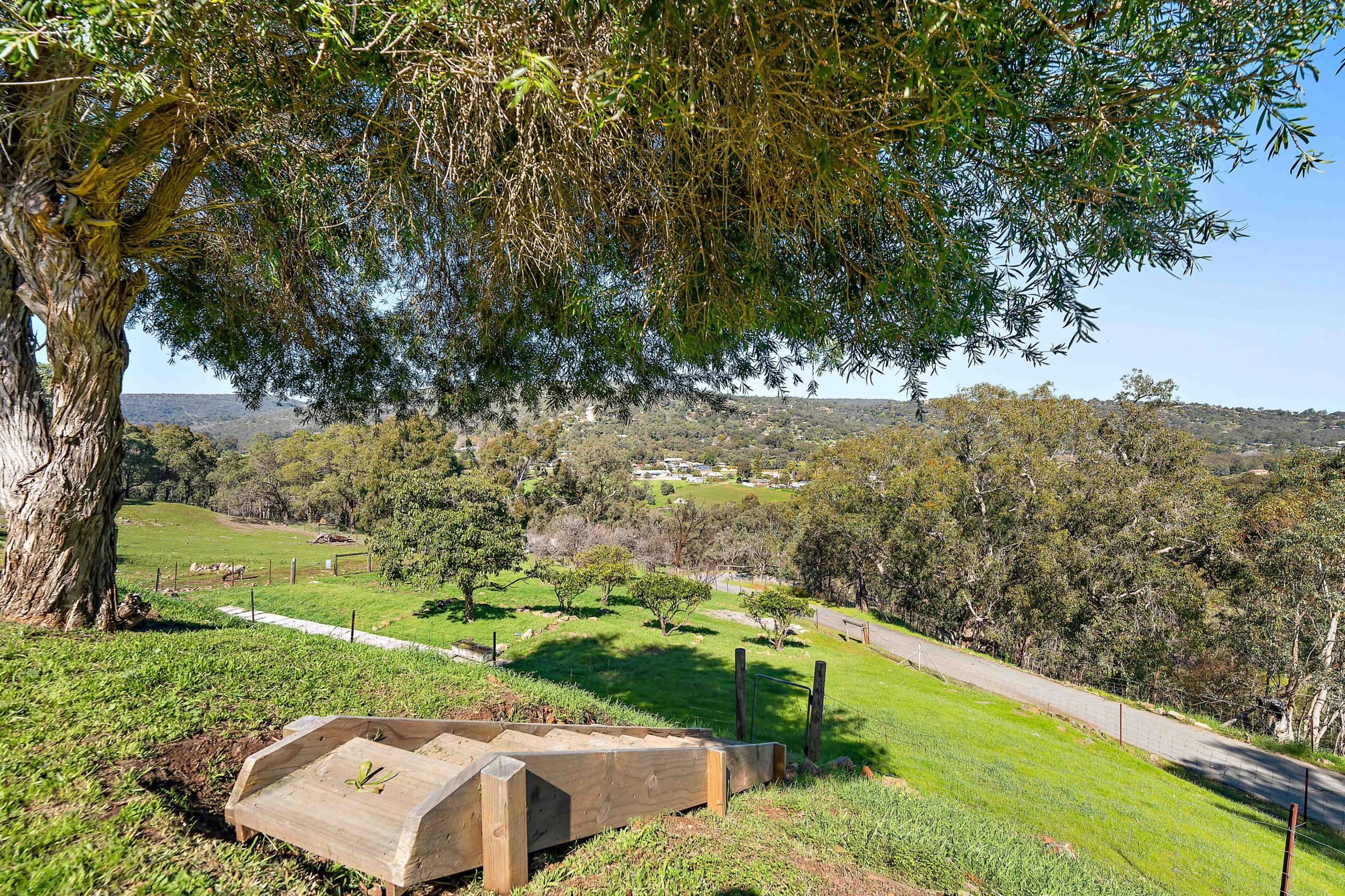
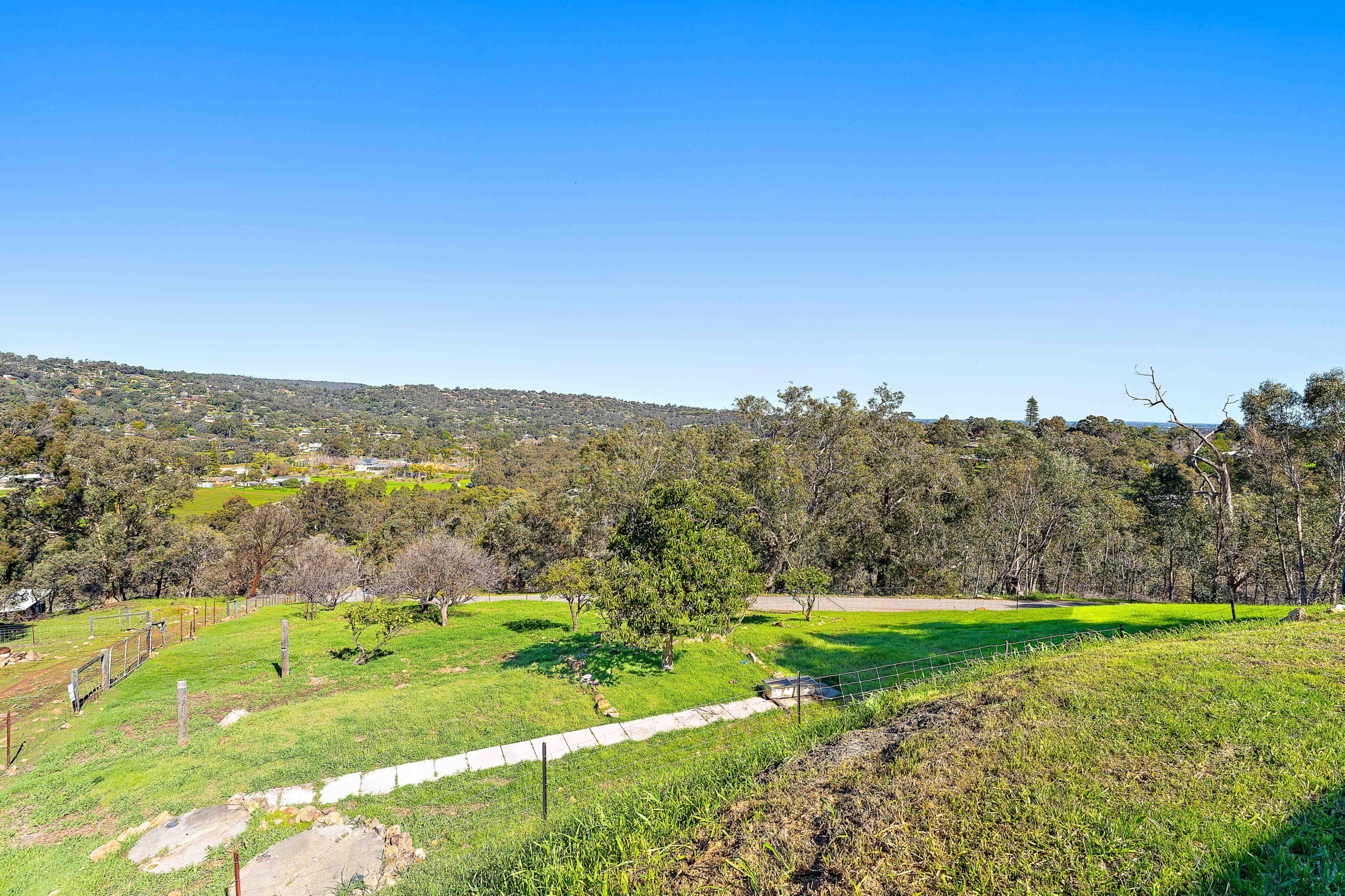
Valley views from a Kelmscott hills home. Outlook is one of the many things an automated valuation cannot properly measure.
Character, natural light and connection to the landscape are difficult for an automated valuation to measure accurately
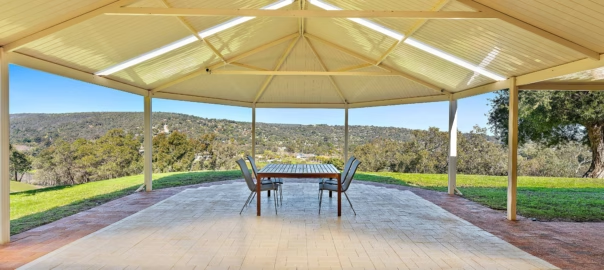
Lifestyle features like this can significantly influence buyer demand but are difficult for online estimates to value accurately

If you are wondering whether your property is one of the ones online estimates get wrong, you can request a free appraisal and we will explain exactly why, with no obligation.

Kelmscott is several markets, not one

The big valuation mistake is treating Kelmscott as if it has a single median value. It does not. It is really a few distinct markets, and which one you are in changes both your buyer and your number.

Central Kelmscott, close to the station, schools and shops, draws families, first-home buyers and investors, and this is where an estimate is most likely to be roughly right, with the big exception of development potential.

The hills-side around Clifton Hills draws lifestyle buyers who pay a premium for elevation, outlook, trees and quiet. Here estimates are weak, because no two blocks present the same way.

The larger hill blocks further out, on the southern side of Canning Mills Road and around Buckingham Road and the Canning River, run from around half an acre up to some of about ten acres. These are lifestyle purchases as much as homes, and they are the hardest of all for a model to value.

And the redevelopment and investment pockets are where the zoning, not the house, is the story. A site with the right zoning can be worth well beyond its value as a place to live.

The part the estimate never sees: development potential

Even on an ordinary central Kelmscott block, the question that can move your value the most is whether the block can be subdivided, and an online estimate has no idea.

As a rough rule of thumb, the things I look at are whether there is side access of around four metres, whether there is enough useable land at the rear, in the order of 350 to 380 square metres including the driveway, and how close the property sits to the train station, because being within around 800 metres of the station can matter. None of those are hard-and-fast rules, they are simply the kind of things that flag a block worth investigating. The actual subdivision rules depend on the zoning and the current planning requirements, and they must be confirmed with the City of Armadale before you rely on them.

These are only indicators that tell me a property deserves a closer look. Some properties that do not meet every one of them can still have development potential, and others that tick every box may not. Every property has to be assessed individually, which is exactly why an online estimate, which assesses nothing, cannot tell you whether yours has any upside at all.

I have seen what this is worth. Two neighbouring blocks I sold had been valued by three other agents at $500,000 to $550,000 combined. They had all valued the houses. A zoning change meant the land could be redeveloped, and the two sold together for $1.2 million. The houses were exactly the same. The zoning had changed. If you do not know what your block is zoned and what it could become, you do not yet know what it is worth.

What buyers are really paying for

In much of Kelmscott the house is only part of the value. Depending on where you are, buyers are paying for the block size, the zoning and any subdivision or development potential, the hills position and the views, useable land, sheds and workshops, privacy, mains water, the character and feel of the home, and proximity to schools, transport and shopping.

Every property is a different combination of those things, which is precisely why no calculator can weigh them, and why two homes that look similar on paper sell for very different prices. The three-acre home did not reach $1.3 million by chance either. It got there because enough of the right buyers were brought together at once that they had to compete for it, and an algorithm cannot see that competition coming. A local agent who knows the buyer pool can.

If your question is whether to spend money improving any of this before you sell, that is its own decision, and our guide on renovating before selling walks through how to tell the improvements that pay from the ones that do not.

So what is your Kelmscott property worth?

The honest answer is that it depends, and not because agents like dodging the question. It depends because every Kelmscott property is a different mix of house, land, zoning,  position and buyer demand, and those are the things that decide the final price. The only way to know your number is to have someone assess the home, the land, the zoning and the current market together, in person.

Frequently asked questions

What is my Kelmscott house worth?

There is no single answer from a website, because Kelmscott is several markets in one suburb. A central block, a hills home, a lifestyle acreage and a development site are all valued differently, and the same suburb median can be wildly wrong for any one of them. The only reliable way to know is a property appraisal in Kelmscott that looks at your specific home, land, zoning and current buyer demand.

Are online property estimates accurate?

Sometimes roughly, sometimes badly wrong. On a standard central Kelmscott block surrounded by similar recent sales, an online estimate can land in the ballpark. In the hills, on acreage, or on anything with development potential, it has nothing comparable to measure against and can be out by hundreds of tthousands of dollars, as the three-acre example in this article shows.

Does subdivision potential increase value?

It can, significantly, because a developer or investor may pay well beyond a property’s value as a home. But potential has to be real and confirmed. Whether a block can actually be subdivided depends on its zoning and the current City of Armadale planning rules, so it should always be checked before you rely on it.

How much does a property appraisal cost?

Our property appraisals in Kelmscott are free and come with no obligation. You get an honest assessment of what your home is worth and why, including any potential in the block, with no pressure to list.

Find out before you assume

If you are even thinking about selling, the most valuable thing you can do first is get the block assessed properly, before you assume your home is just another Kelmscott house, and before you set a price off a website.

We are based right here in Kelmscott, we have sold across this suburb and the Foothills since 2002, and we hold a 4.9 star rating on Google across more than 160 reviews and 4.9 on RateMyAgent. We will tell you what your property is genuinely worth, including any potential in the block you may not know is there, and we will be honest about it.

It is free, there is no pressure, and it is backed by our Best Service Guarantee.

Call the office on 08 6254 6333, or get in touch with me directly. Book your free Kelmscott property appraisal today.

Truth. Strategy. Sold.

This article is general information based on more than two decades of selling property in the Perth Hills and Foothills. It is not formal valuation, planning or financial advice. Subdivision and development potential depend on zoning and current planning rules and must be confirmed with the City of Armadale. The figures in the example relate to one specific sale. For a figure you can rely on, get an appraisal of your own property.

Should I Buy a House Before Selling Mine? (WA Subject to Sale Guide)

I will buy your home, but only if mine sells first.

That, in plain terms, is a subject to sale offer. And the question behind it is one of the most common we hear from homeowners across Bedfordale, Kelmscott, Roleystone, Mount Nasura, Mount Richon, Seville Grove and the wider Perth Hills and Foothills. Should we buy first, or sell first?

The honest answer is that it depends on you. Sometimes buying first is exactly the right move. Other times it turns into an expensive mistake. After personally helping people buy and sell more than 1,500 homes since 2002, I have seen both approaches work, and I have seen both go badly wrong. Here is how to tell which one you are looking at.

The short answer

If your finances allow it, selling first usually puts you in the strongest position. You know exactly what your home has sold for. You know how much equity you have to work with. You know your budget with certainty. And you become a far stronger buyer, because you can make an offer without needing to sell anything first.

But life is not always that tidy. You may have found the home you really want. You may want to avoid moving twice. Or you may need the money from your current home to fund the next one. That is where a subject to sale offer comes in. The important thing is understanding exactly how it works before you sign anything.

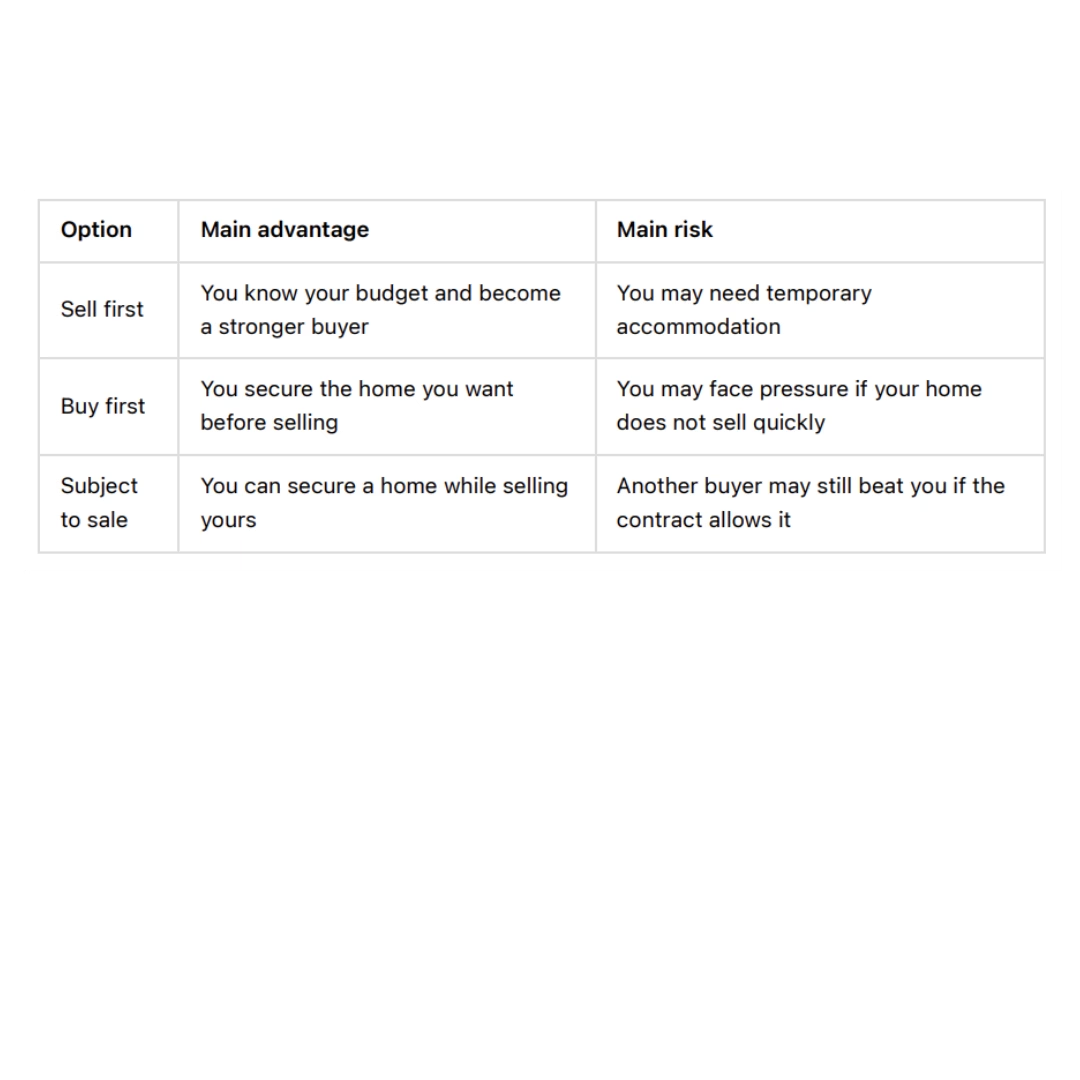
Here is how the three paths compare at a glance:

What is a subject to sale offer?

A subject to sale offer lets you make an offer on another property that only becomes unconditional once your own home is sold. It can be an excellent solution. It also carries risks that a lot of people do not fully understand until they are in the middle of one.

The truth about subject to sale offers

These offers have picked up a bad reputation over the years, and in my experience it is mostly undeserved.

We do a lot of them, partly because of where we are. In the Hills there is a steady stream of people moving up from the flats into a bigger home on a bigger block, and most of them need to sell before they can buy. Across my own sales over more than two decades, and I have handled hundreds of these, roughly three in four of the buyers we work with are also sellers. That is a figure from my own records, not a market statistic, and it is simply how this part of the market moves.

So why do so many agents dislike them? Because they are more work. They need careful planning, constant communication, realistic pricing and someone actively managing two transactions instead of one. It is easier to deal with a straightforward cash or financeapproved buyer.

Here is the part I have never understood. A lot of agents will flatly refuse. No, we do not take subject sales on this home. I take them on, and I win a good number of listings precisely because the agent down the road would not. Helping people move is the job. For a lot of ffamilies, a subject to sale offer is simply the most practical way to make that move happen.

These offers can benefit sellers too

A buyer who has finally found the home they want, and who needs that exact property to make their move work, will sometimes pay a premium for the chance to buy it subject to the sale of their own home.

From the seller’s side, accepting a well prepared subject to sale offer is not always a disadvantage. If the buyer’s home is ready for sale, their price expectations are realistic and the deal is managed properly, the seller can come out ahead of where another buyer would have left them. Like most things in real estate, it is not about whether a subject to sale offer is good or bad. It is about how well it is structured.

A recent example from Bedfordale shows how this works in practice. I had clients who had found the home they wanted in Bedfordale but needed to sell their own place first. Rather than lock them into a 48-hour clause, I sat down with the sellers and walked them through the situation. They were happy to give my clients a few weeks without the 48-hour clause being invoked, so my clients had room to get their own home ready and onto the market properly.

They trusted the advice. We got the home ready. We launched it. Nine days later it was  sold. Both sides came out happy: the sellers in Bedfordale got their result, and my clients secured the home they had moved for. No scramble, no two-business-day countdown hanging over anyone. Just a prepared buyer, a reasonable seller and an agent willing to negotiate the breathing room. Planning beat panic.

Pricing your home honestly is what makes it work

This is make or break, and it is where most failed subject to sale deals actually fail. When one falls over, it is almost always because the home was overpriced. It sits, it takes too long, sometimes it does not sell at all, and the buyer loses their dream home in the process. That is not the fault of the strategy. It is the fault of an agent who would not sit across from the seller and tell them the truth on price.

Remember why you are moving. A bigger block. Room for the kids. A workshop. A bigger kitchen for the cook in the family. Keep your eyes on that and the pricing decision gets a lot easier. Your goal here is not to set a suburb record. Your goal is to move.

Sometimes that means accepting that chasing your absolute top number is the expensive option, not the safe one. The seller who holds out for the last five or six per cent and loses the home they were moving for walks away worse off on both ends of the deal. Pricing to sell is how you protect the thing you actually came for.

Have your home ready to go, that day

One of the biggest mistakes buyers make is finding their dream home before getting their own property ready.

When you sign an offer with a subject to sale condition, the contract says your home goes on the market straight away, that day, at a set price. You do not get two or three weeks to get it ready. A week to declutter and tidy is fine. A full renovation to chase a higher price is not, and trying to squeeze one in is how people lose the home they were moving for.

So before you go looking, have it all lined up. Photography, marketing, presentation and price, ready to launch on day one. The faster your home hits the market, the better your chance of securing your next one.

Not ready to call yet? Before you do anything else, find out what your home is actually worth. It is free, it takes the guesswork out, and it is the one number every other decision depends on. Book a free appraisal

What is the 48-hour clause?

Many subject to sale contracts include a special condition commonly called the 48-hour clause. The name is misleading and the detail matters.

It lets the seller of the home you want keep marketing their property while your sale is pending. If they receive another offer they want to accept, usually an unconditional one, they must formally notify you. From that notice you get two business days, not a literal 48 hours, to do one of three things: waive your subject to sale condition and go unconditional, secure a contract on your own home, or arrange home to home finance (what used to be called bridging finance). If you cannot do any of those inside the two business days, the contract is cancelled, your deposit is returned to you, and the seller is free to accept the other offer.

Here is the part most agents will not tell you. That clause is negotiable. It is not automatic and it is not compulsory. When I represent the seller of a home a subject to sale buyer wants, and the offer in front of me is genuinely strong, I will often advise my seller to give that buyer three to four weeks with no 48-hour clause at all. The reasoning is simple. A buyer who was instead subject to finance would tie the property up for three to four weeks anyway. So a well prepared subject to sale buyer, with a realistically priced home ready to launch, is not necessarily exposed to the pressure people fear. That is my own practice, not a rule, and clause wording varies from contract to contract, so always read yours and get advice before you sign it.

Choosing the right agent matters more here than anywhere

If you are buying before selling, the agent you choose becomes the whole game. You are not just looking for someone to advertise your home. You need someone who will actually take a subject sale on, who will tell you the honest truth on price, who understands how these transactions work, who can communicate properly with the agent on the other side, who already has buyers to bring through your home, and who can keep two deals moving toward settlement at the same time. Experience is the difference.

Are there other options?

Depending on your financial position, alternatives can include:

  • Negotiating a longer settlement so you have time to sell.
  • A rent-back arrangement after settlement.
  • Home to home (bridging) finance.
  • Selling first, then negotiating a longer settlement on your purchase.
  • Selling with a strategy built to create buyer competition, such as our Select Date Sale® method.

Every situation is different, which is exactly why strategy comes before paperwork.

So, should you buy before selling?

Sometimes. If you are financially comfortable and you understand the risks, it can work extremely well. If your finances are tight and your home is not ready for market, selling first is usually the safer road. There is no one size fits all answer. The right call depends on your equity, your borrowing capacity, the current market, the property you are chasing, and your appetite for risk.

Before you fall in love with another property, know three things:

  • What your current home is worth.
  • What it is realistically likely to sell for in today’s market.
  • Which selling strategy gives you the best chance of success.

Those three answers remove most of the uncertainty. They are also completely free to find
out.

Thinking about your next move?

If you are planning a move anywhere across the Perth Hills or Foothills, we are happy to talk it through. We will explain the strategies open to you, give you an honest estimate of what your current home is worth, and help you decide whether buying before selling is the right move for you.

No pressure. Just straight advice backed by more than 1,500 personal home sales since 2002.

Call the office on 08 6254 6333, or get in touch with me directly.

Truth. Strategy. Sold.

Book your free appraisal today.

This article is general information based on more than two decades of selling property in the Perth Hills. It is not legal advice. Subject to sale and 48-hour clause wording varies from contract to contract. For your own situation, especially anything involving the contract terms, finance or settlement, speak to a licensed settlement agent or a property lawyer.


About the author: Brendan Leahy has been selling homes across the Perth Hills and Foothills since 2002, with more than 1,500 personal sales. Read more about Brendan.

What Is My Roleystone Property Worth in 2026?

If you have typed your address into one of those free online valuation tools, you have probably already noticed the problem. The number it gave you for your Roleystone home either felt far too low, or suspiciously high, and either way it did not feel right.

There is a reason for that. Roleystone is one of the worst places in Perth to trust an automated valuation, and I can prove it with a home I sold here.

After more than two decades selling across the Hills, and more than 1,500 sales since 2002, I have watched these online estimates get Roleystone wrong over and over again. Not by a little. Sometimes by hundreds of thousands of dollars. Here is why, and here is how you actually find out what your home is worth.

Why the online number is almost always wrong in Roleystone

An automated valuation works by looking at recent sales of similar homes nearby and doing the maths. In a suburb full of near identical brick and tile houses on near identical blocks, that can get reasonably close, because there are plenty of genuine comparable sales to work from.

Roleystone is the complete opposite of that.

Almost no two properties here are the same. One block is steep and treed, the next is flatand cleared. One home is on scheme water, the next runs off a bore and rainwater tanks. One has a valley view that buyers will pay a fortune for, the one next door looks straight into the hill behind it. There are sheds with three phase power, workshops, studios, and homes built in ways you simply do not see down on the flats.

An algorithm cannot see any of that. It does not know the land is useable rather than a cliff. It does not know there is a forty foot shed with power. It cannot stand on the veranda and see the sunset. So in a suburb like ours, where the value lives almost entirely in the things a computer cannot measure, the online number is little more than a guess dressed up as a figure.

A real Roleystone example

Here is the one that shows it best.

I sold a home here in Roleystone, just off the Brookton Highway. The automated valuation system put it at $380,000.

It was nothing like a standard home. It was a pole log build, sitting in amongst the trees, with wonderful views and a beautiful veranda you could sit out on and watch the sunsets. The closest thing I can compare it to is something out of Margaret River. It was absolutely
stunning, and it was completely unlike the brick and tile homes the computer was comparing it against.

We put it on the market from $550,000. The marketing campaign pulled so much inquiry in the first 24 hours that we lifted the starting figure to $600,000. It sold for $670,000.

That is $290,000 above what the automated system said the home was worth. Not because anyone got lucky, but because the value of that property lived entirely in the things no database will ever hold: the build, the setting, the trees, the views, the feel of the place when a buyer walked in. A computer was never going to get within a bull’s roar of it.

What an algorithm cannot see, and what Roleystone buyers actually pay for

The cruel irony is that the things online tools miss are the exact things Roleystone buyers care most about. When I appraise a home here, these are the value drivers I am weighing up, and not one of them is in any automated model:

  • The land itself: how big it is, how much of it is genuinely useable, steep against flat,
    cleared against treed.
  • Water: scheme water, a bore, rainwater tanks, or some combination.
  • Views and aspect, and what the home does with them.
  • Sheds, workshops, studios and outbuildings, and crucially whether they have power and what they are actually good for.
  • Access: sealed or unsealed, the driveway, how far the home sits back.
  • The build itself. Non standard homes like pole, log, mud brick or rammed earth confuse an algorithm completely, because it has nothing to compare them to.
  • The bushfire rating, the privacy, and the simple feel of standing on the block.

Two homes on the same street, on paper almost identical, can sell hundreds of thousands of dollars apart because of these things. That is the Roleystone market. It rewards properties that are special, and it punishes any attempt to value them off a spreadsheet.

Why getting the number wrong costs you either way

Trusting the online figure is not a harmless shortcut. It costs you in both directions.

Price off a low estimate, and you can hand away tens or even hundreds of thousands of dollars, the way that pole log home would have if the owner had believed the $380,000. Price off an inflated one, and your home sits on the market, goes stale, and buyers start to wonder what is wrong with it. By the time you correct it, you often end up taking less than you would have if you had priced it properly from day one.

Either way, the cause is the same: someone was not honest about the number. A real valuation is not the highest figure you can be told to win your business. It is the right one, from someone who has actually stood on blocks like yours and sold them.

So how do you actually find out what your Roleystone home is worth?

You get someone to come and stand on it.

A proper appraisal means walking the land, looking at the shed, checking the water, seeing the views, understanding the access and the build, and knowing from real experience what Roleystone buyers will pay for all of it. That is not something that can be done from a desk,
and it certainly cannot be done by a website.

It is also where the right strategy earns its money. That pole log home did not reach $670,000 by accident. You get your best price by creating genuine competition between buyers who want the property, which is exactly what our Select Date Sale® method is built to do. The starting figure is not the finishing figure when the campaign is run properly.

We have sold across Roleystone and the wider Hills for more than two decades, we hold a 4.9 star rating on Google across more than 160 reviews and 4.9 on RateMyAgent, and we will give you an honest figure rather than the one that sounds nicest.

Find out what your home is really worth

If you want to know what your Roleystone property is genuinely worth in today’s market, not what a website guessed, get a proper appraisal before you make any decisions.

It is free, there is no pressure, and you can cancel at any time and only pay for the marketing actually spent if you ever do list with us. Just a straight, experienced opinion on what your home is worth and what it would take to get you there.

Call the office on 08 6254 6333, or get in touch with me directly.

Truth. Strategy. Sold.

Book your free appraisal today.

This article is general information based on more than two decades of selling property in the Perth Hills. It is not formal valuation or financial advice. Every property is different, and the figures in the example above relate to one specific sale. For a figure you can rely on, get an appraisal of your own home.

How Much Does It Cost To Sell A House In Western Australia?

Most agents are vague about what it costs to sell a house. There is a reason for that: one of
the biggest costs is their own fee, and the less you think about it, the better for them. We would rather just show you the lot. Here is every cost a WA seller actually faces, what each one roughly runs to, and the one big cost most people brace for that is not yours to pay at all.

First, the cost that is not yours: stamp duty

A lot of sellers worry about stamp duty. On the home you are selling, you can cross it straight off your list. In Western Australia, transfer duty (stamp duty) is paid by the buyer, not the seller.

It only becomes your cost when you buy your next home, and there it is one of the biggest upfront numbers you will face. On a $750,000 purchase the duty is around $29,740 at the time of writing, money you need on top of your deposit. It is genuinely one of the biggest things that holds people back from making their next move, so it is worth knowing your number before you start. You can work it out in seconds with our stamp duty calculator. Hold that $29,740 figure in mind. It matters again in a moment.

A quick aside: where stamp duty came from

It is worth knowing what that $29,740 actually is, because it puts the whole thing in perspective. Stamp duty began in colonial Australia as a small tax on legal documents, with some duties charged as low as one shilling. Property conveyance duty, though, was value-
based from the early colonial period, charged as a few shillings per hundred pounds of value, and it has grown from there into a major state revenue source.

Today, transfer duty raises WA roughly three billion dollars a year, somewhere around six to seven per cent of the entire state budget. That is why it has survived. Economists across the political spectrum regard stamp duty as one of the least efficient taxes in the country, because it punishes people for moving house, downsizing or relocating for work. But replacing several billion dollars of annual revenue is politically difficult, so the tax endures, and the bill keeps landing on the buyer at every sale.

None of which you can do anything about as a seller. But it is worth understanding that the single biggest cost in the whole transaction is not your agent. It is the tax the government collects from your buyer for processing the transfer.

The costs you do pay

1. Agent commission
There is no regulated or fixed commission rate in WA. It is negotiable and varies between agents, commonly somewhere around 2% to 3% of the sale price. Our rate is 2.5%, and it
includes GST.

On a $750,000 sale, that 2.5% works out to about $18,750. We will always show you that figure in dollars, not just a percentage, because you deserve to see exactly what you are
paying.

Now here is the part most agents will never point out. On that same $750,000 home, the buyer hands the WA government around $29,740 in stamp duty (the figure from above). The government collects roughly eleven thousand dollars more than your agent does, for processing the transfer, while your agent does the actual work of marketing the home, creating buyer competition, negotiating and getting it sold.

We do not raise that to make light of our fee. We raise it because a cost only means anything in context. The real question is never “what is the percentage.” It is “what do I walk away with, and who gets me the best result for it.” More on the right way to weigh commission in our guide to agent commissions, and the warning signs in.

2. Marketing and advertising
Marketing is usually charged separately from commission. The cost depends entirely on the campaign: professional photography, video, floorplans, portal listings on the major sites, a signboard, and any print or social advertising. A modest campaign might be a few hundred dollars; a full premium campaign on a higher-value home can run to several thousand.

Two honest points. First, ask any agent for the marketing cost in writing before you sign, not after. Second, with us you are not locked in: under our Best Service Guarantee you can cancel at any time and only pay for the marketing actually spent.

3. Settlement agent or conveyancer
You engage your own settlement agent to handle the legal transfer of the property. Conveyancing fees in Australia typically run somewhere between $500 and $2,000, depending on the complexity of the transaction. It is worth getting a quote up front so there are no surprises at settlement.

4. Mortgage discharge (if you have a loan)
If there is a mortgage on the property, it has to be discharged at settlement. That involves two small costs: a discharge administration fee charged by your lender (varies by lender, usually a few hundred dollars), and a fee to register the discharge of mortgage with Landgate (a set government fee, around $200 at the time of writing and indexed each July). Your lender and settlement agent will confirm the current amounts.

5. Rates and water adjustments
This one is not really a fee, but it affects what you walk away with. At settlement, council rates, water rates and any strata levies are adjusted between you and the buyer so each side pays only for the portion of the period they owned the home. You settle your share up to settlement day. It is an adjustment, not a charge, but it comes out of your proceeds.

Costs that apply only in some situations

  • Capital gains tax. If the property is your family home (your main residence), it is generally exempt. CGT usually only applies if you are selling an investment or rental property. The rules are detailed and currently under review at a federal level, so this is a question for your accountant, not your agent. We are not tax advisers.
  • Fixed-rate loan break costs. If your home loan is on a fixed rate and you break it early,
    your lender may charge a break fee. Ask your lender before you list.
  • Presentation and repairs. Optional, but often worth it. What pays off and what does not is covered in should I renovate before selling.

So what does it actually add up to?

Here is an illustrative example on a $750,000 sale. Your numbers will differ, but it shows the
shape of it.

In a typical sale, the costs beyond commission come to a few thousand dollars. The single
largest cost, by a wide margin, is the commission, and the single largest variable is the sale
price the commission is charged on.

The honest point most agents will not make

The cost that actually matters is not any one line on that list. It is your net: the sale price
minus everything above.

A cheaper agent who sells your home for less can leave you thousands worse off than a better agent who gets a higher price. That is exactly what our Select Date Sale method is built to do. Instead of locking your home to a single fixed asking price, which can sit too high and go stale or too low and leave money on the table, it creates genuine competition
between qualified buyers to find the real top price. Two thousand dollars saved on a fee
means nothing if the same agent leaves twenty thousand on the table.

So by all means understand every cost. Then judge an agent on the number that counts,
what you are left with at the end, not the fee they advertise at the start. You can model your own numbers with our cost of selling calculator, and if you want the real figures for your home, that is what an appraisal is for.

Want the exact numbers for your home?

Book a free, no-obligation appraisal with Brendan Leahy. We will give you a realistic sale price for your property and suburb, walk you through the costs that actually apply to you, and show you your likely net in writing. Fifteen to thirty minutes, no pressure, whether you are selling soon or just want to know where you stand. Selling property across the Perth Hills and Foothills since 2002.

Truth. Strategy. Sold.

Book a free appraisal | 08 6254 6333 | Unit 1/198 Brookton Highway, Kelmscott WA 6111

How Long Does It Take To Sell A House In WA?

One of the first questions homeowners ask when considering selling is:

“How long will it take to sell my house?”

The honest answer is simple:

It depends.


Some homes sell within days of hitting the market. Others can take weeks or even months.

Many articles quote average days on market statistics as though they apply to every property.

The reality is they don’t.

As a guide, Perth’s median selling time has ranged from almost two months during slower markets to as little as seven days during some of the strongest seller’s markets in recent years.

Yet two homes can come to market on the same day and sell weeks apart.

Why?

Because the factors that influence selling time go far beyond the Perth average.

The good news is that many of those factors can be managed or improved.

There Is No One-Size-Fits-All Answer

While average days on market figures for Perth can provide a useful benchmark, they should never be used to predict how long an individual property will take to sell.

A family home in Seville Grove may attract a completely different buyer pool to an acreage property in Bedfordale or a lifestyle property in Roleystone.

Different suburbs, different price points and different property types often sell at very different speeds.

That’s why local market knowledge matters.

The Five Biggest Factors That Affect Sale Time

1. Price

Pricing is generally the biggest factor you can control when it comes to how quickly a property sells.

Properties priced correctly for the current market generally attract more buyer interest and inspections.

Properties priced too high often sit on the market while buyers move on to competing homes.

Many sellers believe starting high gives them room to negotiate.

In reality, overpricing often reduces enquiry levels and can ultimately lead to a lower sale price.

2. Buyer Demand

Some suburbs simply have more buyers than others.

When buyer demand is strong, properties typically sell faster.

When buyer demand is weaker, properties can take longer to find the right purchaser.

Demand can also change throughout the year depending on:

  • Interest rates
  • Economic conditions
  • School terms
  • Consumer confidence
  • Local supply levels
3. Presentation

First impressions matter.

Well-presented homes generally attract more inspections and stronger offers.

Simple improvements such as:

  • Decluttering
  • Fresh paint
  • Garden maintenance
  • Minor repairs
  • Professional photography

can significantly improve buyer interest.

4. Marketing Strategy

A property with poor marketing may struggle to reach enough buyers.

A property exposed to the largest possible buyer audience often generates more competition and stronger results.

Good marketing should include:

  • Professional photography
  • Strong online exposure
  • Social media promotion
  • Database marketing
  • Clear pricing strategy
5. Property Type

Some property types naturally take longer to sell.

For example:

  • Entry-level homes often attract larger buyer pools.
  • Unique acreage properties can require a more specialised buyer.
  • Luxury homes may have fewer potential purchasers.

That doesn’t mean these properties won’t sell well.

It simply means finding the right buyer may take longer.

How Long Does It Take To Sell In The Perth Hills?

The Perth Hills market is unique.

Suburbs such as Bedfordale, Roleystone, Mount Richon and Mount Nasura contain many properties that are unlike anything else available in Perth.

Buyers aren’t simply comparing bedrooms and bathrooms.

They’re comparing:

  • Views
  • Land usability
  • Workshops
  • Horse facilities
  • Water supply
  • Lifestyle features
  • Privacy

Because of this, some Hills properties can attract immediate competition while others require a longer marketing period to connect with the right buyer.

The mistake many Hills sellers make is comparing their property to a standard suburban home.

Unique properties often attract fewer buyers, but the right buyer may be willing to pay significantly more once they see the value in the lifestyle on offer.

Why The First Few Weeks Matter Most

When the pricing, marketing and negotiation are all right, your strongest offers almost always arrive in the first three to four weeks.

That’s when a listing is fresh and buyer interest is at its peak.

In most markets, that early window is when a well-prepared home sells.

After that, the pattern often changes.

Buyers begin to wonder why a property hasn’t sold.

Interest can cool.

Later offers are often no stronger — and sometimes weaker — than the offers available during the first few weeks.

It’s worth asking yourself a practical question too.

Keeping a home show-ready is hard work.

Especially with children, pets or a busy household.

Do you really want to maintain that level of readiness for months, only to achieve a similar result that may have been available much earlier?

This is the thinking behind our Select Date Sale® method.

It’s designed to concentrate genuine buyer competition into that early, high-interest period so the strongest price has the best opportunity to surface while your property is still fresh.

Can You Speed Up The Selling Process?

Yes.

The fastest sales usually happen when five things align:

  • Accurate pricing
  • Professional presentation
  • Maximum buyer exposure
  • Strong negotiation
  • Genuine buyer competition

These are the factors that create urgency.

And when buyers feel urgency and competition, decisions tend to happen faster.

Does Selling Faster Mean Accepting Less?

Not necessarily.

One of the biggest myths in real estate is that a quick sale automatically means a lower sale price.

In reality, many of the strongest sale prices occur when multiple buyers compete for the same property early in the campaign.

The key is not how quickly the property sells.

The key is whether the marketing strategy creates enough buyer competition to achieve the best possible outcome.

So What’s The Real Answer?

Some properties sell in a matter of days.

Some take several weeks.

Others take longer.

The time it takes to sell depends on your property, your suburb, market conditions, pricing strategy and buyer demand.

The best way to understand how long your property may take to sell is to speak with an experienced local agent who understands your market and can assess your property’s individual strengths.

And remember:

A home has no recommended retail price.

There is no sticker on it.

What it sells for — and how fast — comes down to the strategy behind the campaign and the agent running it.

Get both right and you give yourself the best possible opportunity to achieve an exceptional result.

Want To Know How Long Your Property Could Take To Sell?

Book a no-obligation appraisal with Brendan Leahy and the team at Naked Real Estate®.

We’ll provide honest advice on your property’s likely value, current buyer demand and the strategy most likely to achieve the best result.


Related Reading

Truth. Strategy. Sold.

Why Bedfordale Online Valuations Are Often Wrong

If you’ve ever checked the value of your Bedfordale property online, you may have been surprised by the figure you received.

Sometimes the estimate appears too high. More often, it’s significantly lower than what local agents and valuers believe the property is worth.

The reason is simple.

Bedfordale is one of the most difficult suburbs in Perth for an online valuation system to assess accurately.

While automated valuation models can work reasonably well in standard suburban estates where homes are similar, Bedfordale is anything but standard.

Why Online Valuations Work Better In Some Suburbs

Most online valuation systems rely heavily on:

  • Recent sales
  • Land size
  • House size
  • Bedroom count
  • Bathroom count
  • General location data

In suburbs where homes are similar in age, style and block size, this often produces reasonably accurate estimates.

For example, if ten similar four-bedroom homes on 700sqm blocks sell in the same street, an algorithm can usually estimate the value of the eleventh home fairly accurately.

Bedfordale doesn’t work like that.

Bedfordale Isn’t One Property Market

One of the biggest challenges for online valuation systems is that Bedfordale is actually made up of several very different lifestyle precincts.

These include:

  • Wallangarra
  • Churchman Brook Estate
  • Waterwheel Ridge
  • Camfield Estate
  • Camfield Heights

While they all fall under the Bedfordale postcode, they attract different buyers, offer different lifestyles and often achieve very different sale prices.

Wallangarra special rural estate bedfordale

Wallangarra is one of Bedfordale’s original special rural precincts and remains highly sought after for its natural bush setting and larger lifestyle lots.

Wallangarra special rural estate Bedfordale

Waterwheel Ridge is recognised for its premium homes, larger lots and family-friendly environment.

Camfield Estate Bedfordale

Camfield Estate attracts buyers looking for quality homes on generous lifestyle blocks.

Camfield Heights offers elevated positions and some of Bedfordale’s most impressive outlooks.

Churchman Brook Estate is popular for its natural surroundings, walking trails and unique Perth Hills lifestyle.

A property located in one of these precincts can be dramatically different from a property located in another.

Yet many online valuation systems treat them as though they’re part of the same market.

The Features Algorithms Simply Can’t Measure

Many of the factors Bedfordale buyers are willing to pay substantial premiums for are difficult or impossible for automated systems to assess.

These include:

  • Scheme water connection
  • Horse facilities
  • Powered workshops
  • Three-phase power
  • Side access for caravans, trucks and trailers
  • Subdivision potential
  • Valley views
  • City skyline views
  • Privacy from neighbouring properties
  • Established gardens
  • Mature trees
  • Bridle trail access
  • Quality fencing and paddocks
  • Usable flat land

These features can add hundreds of thousands of dollars to a property’s value.

Unfortunately, many online valuation systems either fail to recognise them or place very little weighting on them.

A Real Bedfordale Example

One Bedfordale property demonstrates the problem perfectly.

Two major online valuation systems estimated the property’s value at approximately $1.2 million.

A licensed valuer who physically inspected the property later assessed its value at approximately $3.1 million.

The difference was almost $1.9 million.

Why?

Because the online systems failed to properly recognise:

  • Mains water connection
  • Development potential
  • Large areas of usable land
  • The property’s overall rarity

A qualified valuer standing on the property could immediately identify those factors.

The algorithm couldn’t.

What Bedfordale Buyers Actually Pay More For

After more than two decades selling homes throughout Bedfordale and the Perth Hills, we consistently see buyers paying premiums for several key factors.

Usable Land

A gently sloping or flat block often attracts significantly more buyer interest than a larger block with steep terrain.

Scheme Water

Properties connected to mains water often command stronger prices than similar properties relying entirely on tanks and bores.

Views

Valley outlooks, city skyline views and natural bushland vistas can have a major impact on value.

Workshops And Access

Many Bedfordale buyers place greater value on a large workshop and vehicle access than cosmetic renovations.

Privacy

Privacy remains one of the strongest drivers of demand in Bedfordale and often separates premium properties from average ones.


Should You Trust An Online Valuation?

Online valuations can be useful as a rough starting point.

However, they should never be relied upon when making important financial decisions such as:

  • Selling your property
  • Refinancing
  • Estate planning
  • Family law matters
  • Setting an asking price
  • Accepting an offer

Even the companies providing these estimates include disclaimers stating they should not be relied upon as formal market valuations.


So How Do You Find Out What Your Bedfordale Property Is Worth?

The only reliable method is to have someone physically inspect the property and assess the factors that genuinely influence value.

That means understanding:

  • Which Bedfordale precinct the property sits within
  • Land usability
  • Water infrastructure
  • Access
  • Views
  • Improvements
  • Current buyer demand
  • Comparable recent sales

No algorithm can walk your property.

No algorithm can appreciate your views.

No algorithm can assess your workshop, paddocks or development potential.

A local property expert can.


The Bottom Line

Online valuation tools can provide a useful starting point, but Bedfordale remains one of Perth’s most complex property markets.

When properties range from modern lifestyle homes on 3,000sqm lots through to multi-acre equestrian holdings with subdivision potential, automated systems simply cannot account for all the variables.

If you’re considering selling, refinancing or simply want to understand your property’s current value, a professional appraisal remains the most reliable option.

Related Reading


Want An Honest Opinion Of Your Property’s Value?

Book a no-obligation appraisal with Brendan Leahy and the team at Naked Real Estate®.

Truth. Strategy. Sold.