
Category Archives: Blog

Why Bedfordale Online Valuations Are Often Wrong

If you’ve ever checked the value of your Bedfordale property online, you may have been surprised by the figure you received.

Sometimes the estimate appears too high. More often, it’s significantly lower than what local agents and valuers believe the property is worth.

The reason is simple.

Bedfordale is one of the most difficult suburbs in Perth for an online valuation system to assess accurately.

While automated valuation models can work reasonably well in standard suburban estates where homes are similar, Bedfordale is anything but standard.

Why Online Valuations Work Better In Some Suburbs

Most online valuation systems rely heavily on:

  • Recent sales
  • Land size
  • House size
  • Bedroom count
  • Bathroom count
  • General location data

In suburbs where homes are similar in age, style and block size, this often produces reasonably accurate estimates.

For example, if ten similar four-bedroom homes on 700sqm blocks sell in the same street, an algorithm can usually estimate the value of the eleventh home fairly accurately.

Bedfordale doesn’t work like that.

Bedfordale Isn’t One Property Market

One of the biggest challenges for online valuation systems is that Bedfordale is actually made up of several very different lifestyle precincts.

These include:

  • Wallangarra
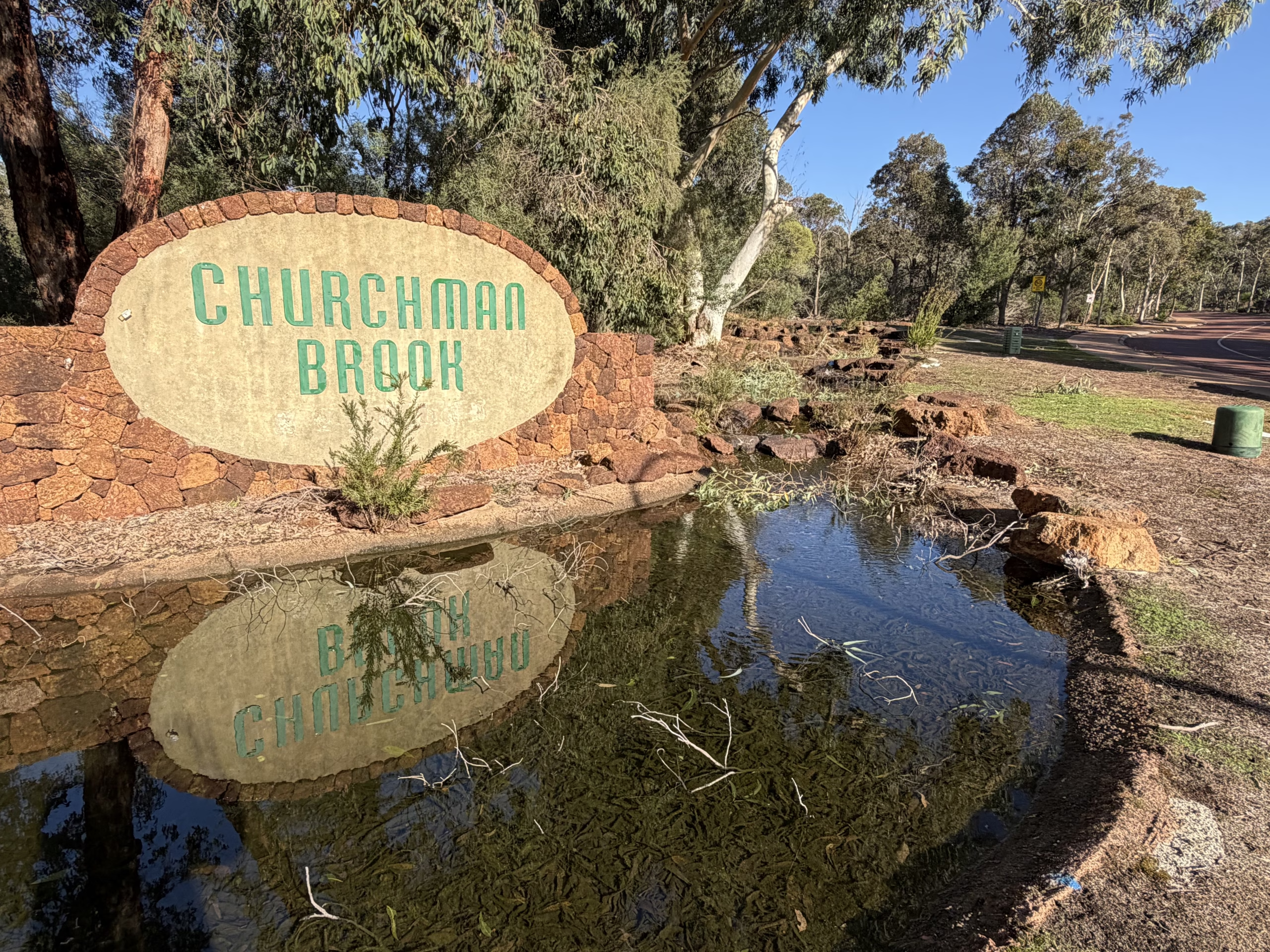
  • Churchman Brook Estate
  • Waterwheel Ridge
  • Camfield Estate
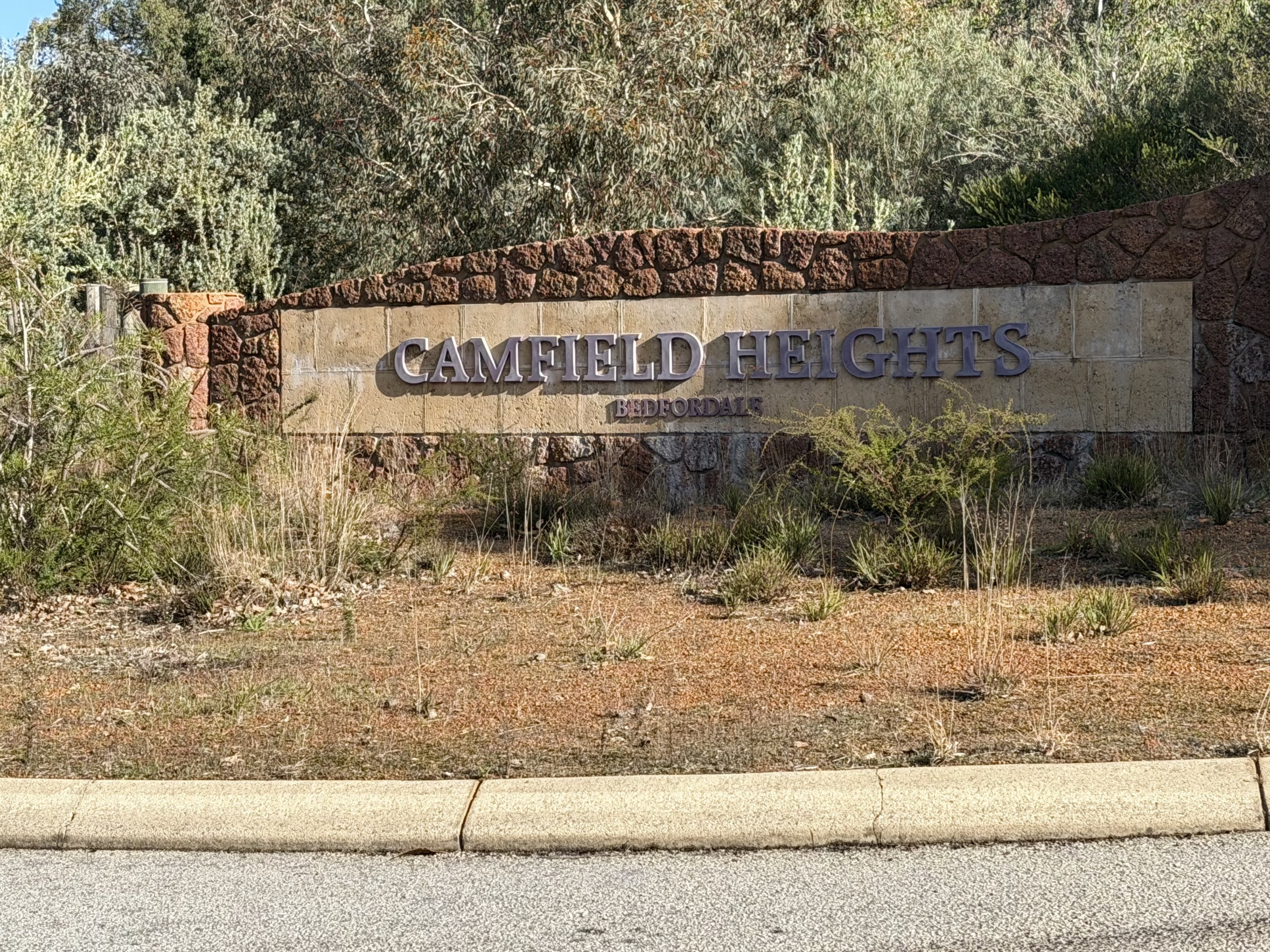
  • Camfield Heights

While they all fall under the Bedfordale postcode, they attract different buyers, offer different lifestyles and often achieve very different sale prices.

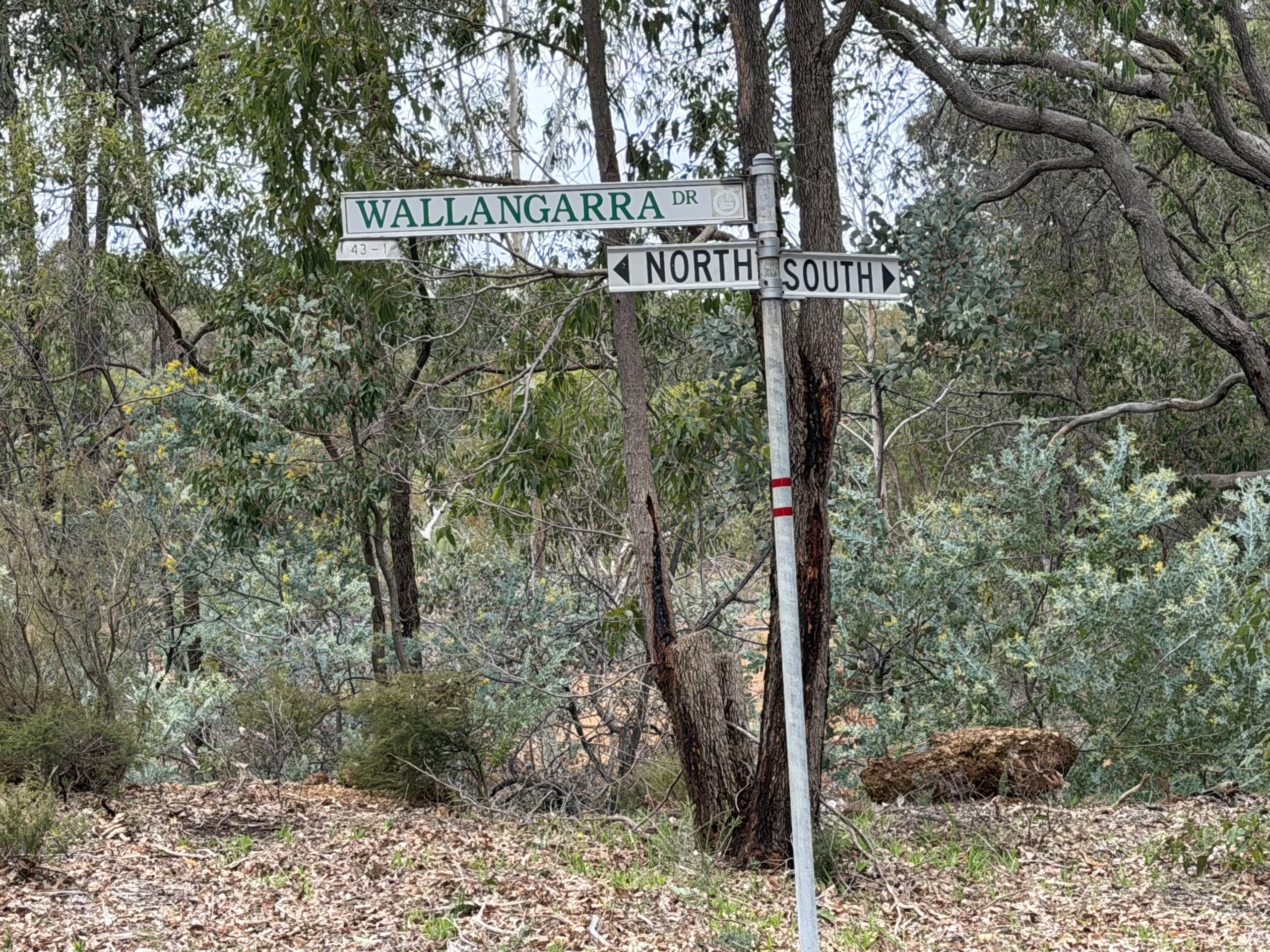
Wallangarra special rural estate bedfordale

Wallangarra is one of Bedfordale’s original special rural precincts and remains highly sought after for its natural bush setting and larger lifestyle lots.

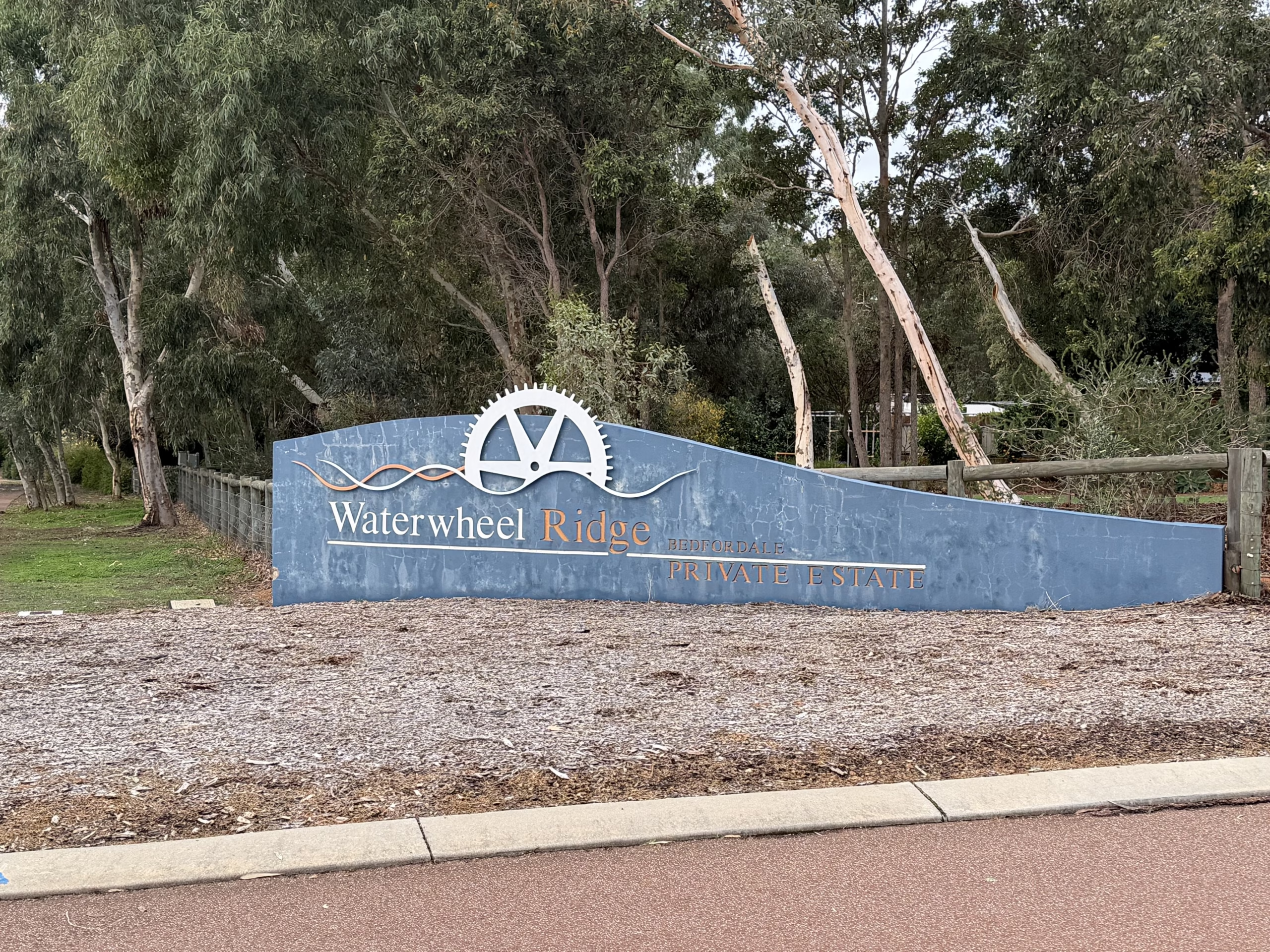
Wallangarra special rural estate Bedfordale

Waterwheel Ridge is recognised for its premium homes, larger lots and family-friendly environment.

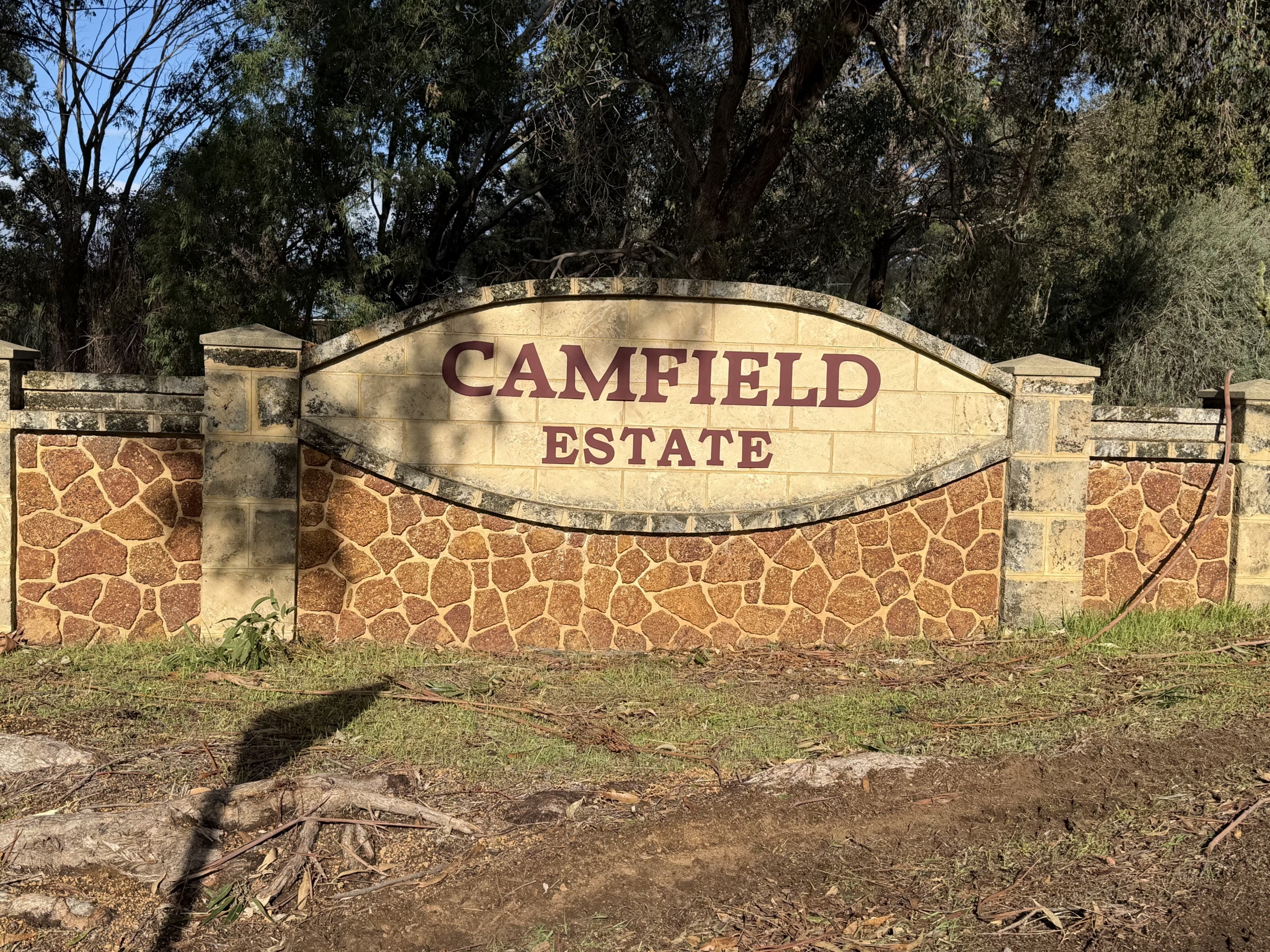
Camfield Estate Bedfordale

Camfield Estate attracts buyers looking for quality homes on generous lifestyle blocks.

Camfield Heights offers elevated positions and some of Bedfordale’s most impressive outlooks.

Churchman Brook Estate is popular for its natural surroundings, walking trails and unique Perth Hills lifestyle.

A property located in one of these precincts can be dramatically different from a property located in another.

Yet many online valuation systems treat them as though they’re part of the same market.

The Features Algorithms Simply Can’t Measure

Many of the factors Bedfordale buyers are willing to pay substantial premiums for are difficult or impossible for automated systems to assess.

These include:

  • Scheme water connection
  • Horse facilities
  • Powered workshops
  • Three-phase power
  • Side access for caravans, trucks and trailers
  • Subdivision potential
  • Valley views
  • City skyline views
  • Privacy from neighbouring properties
  • Established gardens
  • Mature trees
  • Bridle trail access
  • Quality fencing and paddocks
  • Usable flat land

These features can add hundreds of thousands of dollars to a property’s value.

Unfortunately, many online valuation systems either fail to recognise them or place very little weighting on them.

A Real Bedfordale Example

One Bedfordale property demonstrates the problem perfectly.

Two major online valuation systems estimated the property’s value at approximately $1.2 million.

A licensed valuer who physically inspected the property later assessed its value at approximately $3.1 million.

The difference was almost $1.9 million.

Why?

Because the online systems failed to properly recognise:

  • Mains water connection
  • Development potential
  • Large areas of usable land
  • The property’s overall rarity

A qualified valuer standing on the property could immediately identify those factors.

The algorithm couldn’t.

What Bedfordale Buyers Actually Pay More For

After more than two decades selling homes throughout Bedfordale and the Perth Hills, we consistently see buyers paying premiums for several key factors.

Usable Land

A gently sloping or flat block often attracts significantly more buyer interest than a larger block with steep terrain.

Scheme Water

Properties connected to mains water often command stronger prices than similar properties relying entirely on tanks and bores.

Views

Valley outlooks, city skyline views and natural bushland vistas can have a major impact on value.

Workshops And Access

Many Bedfordale buyers place greater value on a large workshop and vehicle access than cosmetic renovations.

Privacy

Privacy remains one of the strongest drivers of demand in Bedfordale and often separates premium properties from average ones.


Should You Trust An Online Valuation?

Online valuations can be useful as a rough starting point.

However, they should never be relied upon when making important financial decisions such as:

  • Selling your property
  • Refinancing
  • Estate planning
  • Family law matters
  • Setting an asking price
  • Accepting an offer

Even the companies providing these estimates include disclaimers stating they should not be relied upon as formal market valuations.


So How Do You Find Out What Your Bedfordale Property Is Worth?

The only reliable method is to have someone physically inspect the property and assess the factors that genuinely influence value.

That means understanding:

  • Which Bedfordale precinct the property sits within
  • Land usability
  • Water infrastructure
  • Access
  • Views
  • Improvements
  • Current buyer demand
  • Comparable recent sales

No algorithm can walk your property.

No algorithm can appreciate your views.

No algorithm can assess your workshop, paddocks or development potential.

A local property expert can.


The Bottom Line

Online valuation tools can provide a useful starting point, but Bedfordale remains one of Perth’s most complex property markets.

When properties range from modern lifestyle homes on 3,000sqm lots through to multi-acre equestrian holdings with subdivision potential, automated systems simply cannot account for all the variables.

If you’re considering selling, refinancing or simply want to understand your property’s current value, a professional appraisal remains the most reliable option.

Related Reading


Want An Honest Opinion Of Your Property’s Value?

Book a no-obligation appraisal with Brendan Leahy and the team at Naked Real Estate®.

Truth. Strategy. Sold.

Can I Sell My House Without a Real Estate Agent in Western Australia?

Yes, you can. There’s no law in Western Australia that says you must use a real estate agent to sell your home. You’re free to do it yourself.

But “can I?” is the wrong question. After more than two decades selling homes across the Perth Hills, the honest question is “should I?” — and to answer that, you have to understand what the job of selling a home actually is. Because it isn’t putting a sign out the front and waiting for the phone to ring.

Let me walk you through what I’ve seen, with real numbers from real sales, so you can decide with your eyes open.

Is it legal to sell your house without an agent in WA?

Yes. It’s completely legal, and no law requires you to use an agent. But very few people actually do it — research suggests only around 1% of homes sold in Australia are sold without an agent. It’s rare for a reason, and the reason isn’t that people don’t know it’s allowed.

In my experience it’s mostly sellers in the middle-ring and outer-ring suburbs who try it, and the motive is simple: they want to save the commission. You almost never see it at the top end of the market. Those owners already understand the value of a good agent, and they’re usually busy people running a business or working a senior role who have no interest in having ten or twenty strangers wander through their home hoping one of them turns out to be a buyer.

That’s the part most people underestimate. A few weeks in, the typical private seller has had twenty groups through, every one of them saying “lovely home, we’ll get back to you” — and then never calling again. Buyers almost never tell you the truth. They won’t say it’s overpriced, or that they didn’t like the kitchen or the layout. They stay polite and they vanish. That’s real estate. It’s the single hardest thing in this job to get used to, and it’s a big reason so many agents don’t last past their first year.

Will you actually save the commission by selling privately?

Usually not — and often you’ll lose far more than you save. Every time I’ve sat down with someone who sold privately and gone through their numbers, I can see where it went wrong. They think they saved 2.5% in commission. In reality they often gave away 5–10% in the negotiation. They just don’t realise it.

Here’s why. Negotiation is a skill, and if you don’t do it for a living it’s very hard. The classic private-sale negotiation is a tennis match: you drop half, the buyer comes up half, and a few volleys later you’ve settled well below where you should have. The for-sale-by-owner
websites make it all sound easy and tell you they’ve got people to help — but they’re generally not experienced agents. Often there’s just one in the whole organisation who is,
and a fair few of those businesses were started by someone who didn’t make it as an agent.

And you don’t even save on the marketing. Every private-selling platform I’m aware of charges for marketing, paid upfront, exactly as you would with an agent.

People rarely admit any of this afterwards. It’s like buying a car — I’ve never once met someone who said they didn’t like the car they bought. We justify the decisions we’ve made. The seller who left $60,000 on the table will tell you the sale went beautifully, because the alternative is admitting it didn’t.

A real example: a $635,000 private offer that should have been $810,000

This is the one that shows it best. I had a seller in Kelmscott with a subdividable block — a five-unit site once you knocked the house down, or a retain-and-build with three units at the rear. He’d been trying to sell it himself and had a contract sitting in front of him ready to sign.

His daughter rang me. She’d told him not to sign yet and to get me to look at it first. So I went round.

The private offer was $635,000 — low to begin with. But the real danger was buried in how it was structured. The buyer was putting down a $1,000 deposit and taking control of the property for the next 18 months while he pushed a subdivision approval through.

Here’s the mechanism, and almost no seller understands it because it’s perfectly legal. With a tiny deposit and a long settlement, that buyer effectively ties your property up for a year and a half at almost no risk. If the approval comes through, he on-sells it and does what’s called a simultaneous settlement — he settles with you and with his own buyer on the same day, and walks off with the profit, having put in almost nothing but the approval costs. If the market turns or the numbers stop working, he simply walks away. His total loss is $1,000.

Meanwhile you’ve sat there for 18 months believing your home was sold, missing every other buyer that came and went.

We took the property on and advertised it properly. Within 18 days we had an offer of $810,000. The owner had been working off an appraisal a different agent had done three years earlier. He knew the market had risen — he just had no idea how far. That’s $175,000 more than his private contract, on a deal that wouldn’t have tied him up for 18 months.

What can go wrong with the contract and settlement?

A lot — and the contract is where a private seller is most exposed, because it’s the part you
can’t see going wrong until it’s too late. Every sale in WA runs on the Offer and Acceptance together with the Joint Form of General Conditions for the Sale of Land, the standard contract published jointly by REIWA and the Law Society of Western Australia. The system is deliberately simple and clear. But the danger lives in the special conditions, and that’s where experience earns its keep.

Every special condition has to spell out four things: what needs to be done, who has to do it, by when, and what happens for both sides if it isn’t done. Get the wording wrong and you can find yourself paying to fix something, or watching money come off your price at settlement. There are real disclosure obligations too — asbestos, whether your RCDs and smoke alarms are compliant, any caveats on the title, easements and what type they are, covenants controlling what can and can’t be built, and whether everything on the property has actually been approved by the council.

There’s also the paperwork that has to travel with the contract: a copy of the certificate of title, and the Landgate Property Interest Report — an increasingly important document that flags things like bushfire-prone-area status, easements, infrastructure, pool compliance and more. Two compliance points catch people out constantly, and the law is specific: at least two RCDs must be fitted before the title can transfer, and smoke alarms must be mainspowered, less than 10 years old and in working order before transfer, with fines up to $5,000 for getting it wrong.

Let me give you a live example of why the wording matters. Right now I’m selling a home with two older hot water systems. They’re 25 years old, but they work. The buyer has it in his head that he’s buying a brand-new home and wants brand-new units installed. Because the contract was written properly, he hasn’t been able to push that through his settlement agent — and that single piece of correct wording has saved my seller $9,730. It’s the same reason we deliberately exclude things like garden reticulation in our contracts. Come the final inspection, I could turn the reticulation on and one sprinkler head wouldn’t fire — a $3 part — and that alone could hold up an entire settlement. We take it off the table in writing from the start, so everyone knows exactly where they stand before anyone gets stressed.

How much work is there really, once it’s “sold”?

A lot — and most people have no idea how much. If a home sells quickly, the assumption is
that the agent got lucky and did nothing. It’s the opposite. In my experience, around 60% of tthe real work in a sale starts after the contract is signed.

Years ago we mapped our entire process onto the wall of our training room — every step from a buyer’s first contact right through to settlement and beyond.

Part of our process from first contact to settlement, mapped out in our training room

It runs across about a dozen stages and well over a hundred individual steps: first contact,
the appraisal, preparing the listing, running the live marketing campaign, qualifying and following up every single buyer enquiry, the property going under offer, settlement, and the follow-up afterwards — plus separate tracks for when a price needs changing, when a sale falls over, and when a property is withdrawn.

A huge amount of that work sits after a buyer’s offer is accepted — chasing finance week by week, checking the contract conditions, managing the deposit, handling building and pest inspections, and steering the whole thing through to settlement without it collapsing. That’s the part nobody sees from the outside, and it’s the part that protects your price after the handshake. It’s also the exact part a private seller takes on entirely alone.

Aren’t buyers and sellers protected anyway?

This is the part hardly anyone thinks about, and it’s one of the strongest reasons to be careful. When you buy from a private seller, there’s very little consumer protection. If something goes wrong during or after the sale, it’s largely buyer beware. If a private seller isn’t truthful about the property, the buyer often has no real comeback — it becomes one person’s word against the other’s.

A licensed agent is a completely different proposition. In WA we operate under a statutory Code of Conduct, the paperwork is governed jointly by the regulator, the Law Society and REIWA, and complaints can be taken to Consumer Protection. The guidelines are clear and the penalties for breaching them are heavy. That accountability is part of what you’re paying for, and it protects both sides of the deal.

Here’s a dangerous one I see: a buyer offers to rent the home for, say, six months while they “sort out their finance,” then settle. It sounds reasonable. But the people who push this hardest sometimes want the house for something other than living in — including illegal activity — and they’ll bait you with above-market rent and an offer $50,000 or $100,000 over your asking price. Come settlement, the deal evaporates, and the house can be left damaged. In those circumstances your insurance generally won’t cover you at all.

Can’t I just use a settlement agent instead of an agent?

No — they do different jobs, and this trips a lot of people up. A settlement agent is not experienced in how real estate contracts should be written, and they’re not in a position to advise you on how the conditions should be structured. Their job is to follow and execute the contract once it exists. There are clear boundaries between the two roles.

So if you sell privately, you are the one writing those special conditions — the exact thing that, written wrong, costs you money at settlement, as my hot water example shows. The settlement agent picks it up afterwards. Everything before that point — pricing the home, marketing it, qualifying buyers, structuring and writing the contract — is on you.

What about the marketing — can’t I just list it myself?

Not directly on the big portals. realestate.com.au and Domain only allow licensed agents to
list, so a private seller has to go through one of the for-sale-by-owner companies (which are themselves licensed agencies) to appear there at all.

When someone tells me upfront they’re going to sell privately, my advice is always the same: do not skimp on marketing. It’s the most important thing you can do, and don’t leave anything out. It’s like insurance — you don’t know which rock your buyer is going to come out from under. Some buyers only ever look at one website; leave that one out and you can miss a genuinely good buyer.

Where private sellers fall down is the quality. The photography is usually the giveaway, and I don’t think I’ve ever seen a private seller produce a proper video walkthrough. Then there are the brochures and how the home is actually presented. All of it feeds how the home feels when a buyer walks through the door, and how it’s marketed is the difference between one person turning up and twenty turning up.

Which brings me to the line that sits under everything: you don’t get your best price in isolation — you get it with competition between buyers who want your home. Creating that competition is exactly what you should be paying a real estate agent to do.

What happens if your private sale doesn’t work?

This is the part the platforms don’t put on the brochure: if your home doesn’t sell, the “saving” you went in for can quietly disappear, and you can end up paying commission anyway.

One way it happens is you give up after burning your best weeks on the market and start again with an agent — by which point buyers can see the home has been sitting, which weakens your hand before you’ve even relaunched. The other way is sharper. Some of the private-selling sites, if your home hasn’t sold, will on-sell your lead to a real estate agent and I’ve seen arrangements where they then take up to 30% of that agent’s commission when the property finally sells.

So you set out to avoid paying commission, and you can end up paying it anyway — with an extra middleman clipping the ticket on the way through.

Is there ever a good time to sell privately?

Yes — and I’ll be honest about it, because pretending an agent is always the answer would
be dishonest. If a family member wants to buy your home, I have no problem with that at all. Call me, I’ll come round, give you an honest value so it’s fair for everyone, step you through the paperwork and point you to a good settlement agent. The same goes for a divorce settlement, or transferring a property or a half-share between family members. In those cases there’s no marketing and no negotiation to handle, so doing it yourselves makes complete sense.

This game is a long game. It’s not about what an agent can extract from you today — it’s about helping, and that builds relationships that last for decades. All I ask in return is that people are upfront. Don’t get me out to do a full appraisal and then find out a week later it was only to shop me for a number. Be straight with me and I’ll be straight with you. That’s how I like to operate.

So, should you sell your house without an agent?

For the reasons above, unless it’s a family member or an internal transfer like a divorce or a change of ownership between relatives, I wouldn’t. I genuinely can’t think of another
situation where it’s a good idea. Yes, sometimes a private sale goes through smoothly —that does happen — but there are too many variables for it to be the simple process the websites make it out to be.

The biggest one is emotion. Yours, as the seller, swinging up and down through the whole process. And the buyer’s, once they’re in a position to buy, doing exactly the same. That emotional tug-of-war on both sides is what quietly kills private sales — and it’s the reason I never sell my own homes myself. I’m too attached, too sure of where I think the price should be. I bring in another agent specifically because I need someone removed from the emotion to tell me what I need to hear.

So here’s the one thing I’d want you to walk away understanding. Stop thinking of it as “selling a home.” You’re not selling a home — the sale is just the outcome. The actual job, the thing you or your agent should be doing properly, is marketing the property, negotiating the sale, and getting it safely through to settlement. That’s the difference, and that’s where homes are won or lost.

If you’re weighing it up — whether to sell privately, or just whether an agent is worth it — get an honest appraisal before you decide anything. Call the office or get in touch with me directly. No pressure, no game-playing, just a straight conversation about what your home is really worth and what it would take to get you there.

Truth. Strategy. Sold.

This article is general information based on more than two decades of selling property in the Perth Hills. It isn’t legal advice. For your own situation — especially anything involving contracts, disclosure, trusts, or complex ownership — speak to a licensed settlement agent or a property lawyer.

Are Real Estate Agent Commissions Negotiable in WA?

The honest answer: Yes. They’re negotiable. There’s no law in Western Australia that sets what an agent can charge — commissions here have been deregulated for years, and across the state they generally run somewhere between 2% and 3.5%.

So if you want the short answer: yes, you can negotiate.

But after more than two decades selling homes in the Perth Hills, I’ll tell you the truth most agents won’t. The commission rate is the wrong thing to be focused on. The question that actually matters — the only one that ends up in your bank account — is this:

What do I walk away with?

That’s it. That’s the whole game.

Is the cheapest commission actually the cheapest?

No. The cheapest commission is rarely the cheapest outcome. What lands in your pocket is the sale price minus the fees, not the fee on its own. A slightly higher fee that delivers a much higher sale price leaves you better off. Focus on what you walk away with, not the percentage.

Let me show you why the percentage is a trap.

Say Agent A quotes you a cheaper rate and Agent B costs you $10,000 more in fees. Most people stop right there and pick Agent A. Feels like a $10,000 win.

But if Agent B sells your home for $40,000 more than Agent A would have — and that happens more often than you’d think — then the “expensive” agent just put $30,000 more in your pocket. The cheap one cost you money.

$10,000 cheaper but $40,000 less in the sale price is not the cheapest option. It’s the most expensive mistake you can make.

I’m not a discount agent and I’ve never pretended to be. We charge 2.5% including GST, plus marketing. I’ll explain both. But I’d rather be the agent who gets you the highest number than the agent who shaved a few thousand off the fee and left tens of thousands on the table.

How much commission do you charge, and why is marketing separate?

We charge 2.5% including GST — in the normal WA range — plus marketing, paid separately by the seller at cost (around $2,600 on average). We keep the marketing separate on purpose: it removes a conflict of interest that would otherwise push an agent to sell fast rather than for your best price.

Two parts: the commission, and the marketing.

The commission is 2.5% including GST. That sits in the normal range for WA and, in my view, it’s what it costs to run a system that actually creates competition between buyers which is what drives your price up.

The marketing is paid separately, by you, up front. You can put it on a credit card, pay by EFT, or use one of the marketing finance companies that lets you settle it later. On average it works out to around $2,600 a property, and every cent of it is passed through at cost. There’s no markup on it. A REA (realestate.com.au) listing is around $1,500; professional photography and video is around $700; then there’s floor plans, the REIWA and Domain listings, and our in-house printed brochures.

Now — here’s the part most sellers never get told, and it’s the most important thing in this whole article.

We charge marketing separately on purpose. It removes a conflict of interest that
works against you.

Think it through. If the agency paid for all the marketing itself, and the agency is carrying ten properties at $2,600 each, that’s $26,000 a month tied up — and a lot more than that when the market slows and homes take longer to sell. When an agency is that far out of pocket, there is enormous pressure on the agent to get those properties sold fast — not for the best price, just sold — so the business can recover its money.

That pressure doesn’t land on the agency. It lands on you. It shows up as your agent quietly leaning on you to “just take the offer.”

When you pay the marketing yourself, that pressure disappears. The only thing left for me to chase is the best possible price for you, because that’s the only thing I get paid on. Our interests point in exactly the same direction. That’s the way it should be.

Real estate is brutal — and that’s exactly why your agent matters

Here’s something most people never think about. Real estate is almost unlike any other sales job, because you don’t start with a product to sell.

Sell cars, boats, furniture, anything — the product is already sitting there. Your job is just to find the buyer and present it to them. In real estate, you’ve got nothing to sell until you’ve won the listing in the first place. No listing, no income. Put plainly: if you don’t get the listing, you don’t eat.

That makes it one of the hardest businesses in the world to make a living in. The only way you survive long-term is by getting genuine results for your clients and building a reputation over years — and most people who start in this industry can’t do it. In my time I’ve watched the large majority of agents who come into the business come and go again inside a year or two.

So when you’re choosing who to trust with your biggest asset, what you’re really looking for is someone genuinely dedicated to the craft. And that is not about age or how long they’ve held a licence. A newer agent can be outstanding — as long as they’re training and getting sharper every single day. The rule I hold myself to is simple: be one per cent better than I was the day before, every day. The agent you want to avoid isn’t the young one — it’s the one who got their licence, learned the basics once, and stopped.

Are discount real estate agents worth it?

Usually not. An agent who slashes their own fee in seconds is showing you how they’ll cave when a buyer pushes back on your price — and most deep-discount agents survive on volume, not results. A weak negotiator who saves you a few thousand in fees can cost you tens of thousands on the sale price.

Here’s something to test any agent with. Ask them to drop their fee, and watch how fast they fold.

If an agent caves on their own commission in thirty seconds flat, ask yourself one thing: if they can’t hold their ground on their own fee, how hard do you think they’ll fight for yours? A negotiator who panics and discounts the moment they feel like they might lose the listing is showing you exactly how they’ll perform when a buyer pushes back on your price. They’ll fold there too.

The deep-discount agents tend to be the ones selling around ten homes a year. They’re often working on commission only, which means they’re frequently desperate for the next deal — and a desperate negotiator is a weak negotiator. I once overheard one say, out loud, “I’ll get it sold, I don’t care what the deal is, I discounted my commission to win it.” That’s not a strategy. That’s a fire sale, and your home is the fuel.

There’s a reason cut-price models keep failing here. A rate below what it costs to do the job properly can look fine while prices are climbing — anyone can look good in a rising tide. It’s the falling market that exposes the model. By the time you account for GST, company tax and the real cost of employing and training good people — wages and rent have both climbed sharply in recent years — the maths on a bargain-basement fee simply doesn’t hold up through a downturn. Around our corridor, the flat-fee and discount agencies that came through over the years have one thing in common: they’re gone.

The clearest example isn’t local. Purplebricks launched in Australia in 2016 promising to disrupt the industry with a cheap fixed fee. They spent a fortune on advertising and pulled out of the country in 2019 — less than three years later — after heavy losses (their final-year Australian operating loss was around A$34 million). One of the model’s fatal flaws: agents were paid an upfront fee whether the home sold well or not, so there was no real incentive tied to your result. They also picked up a fine from Queensland’s Office of Fair Trading for misleading claims about that fixed fee, and were widely criticised for pressuring sellers to drop their asking prices. Cheap to list. Expensive to sell. Sound familiar?

Proof, not promises

I don’t expect you to take any of this on faith. Here are three real sales.

Roleystone — $53,000 more, in 7 days. A home that had sat on the market for 90 days with a previous agent. Phone photos. A briefcase left sitting on the kitchen bench in the listing pictures. No video. Priced at $750,000 and going nowhere. We relisted it properly using a Select Date Sale, created real competition, and sold it in 7 days — four buyers through, two written offers — for $803,000. Same house. Same market. $53,000 difference.

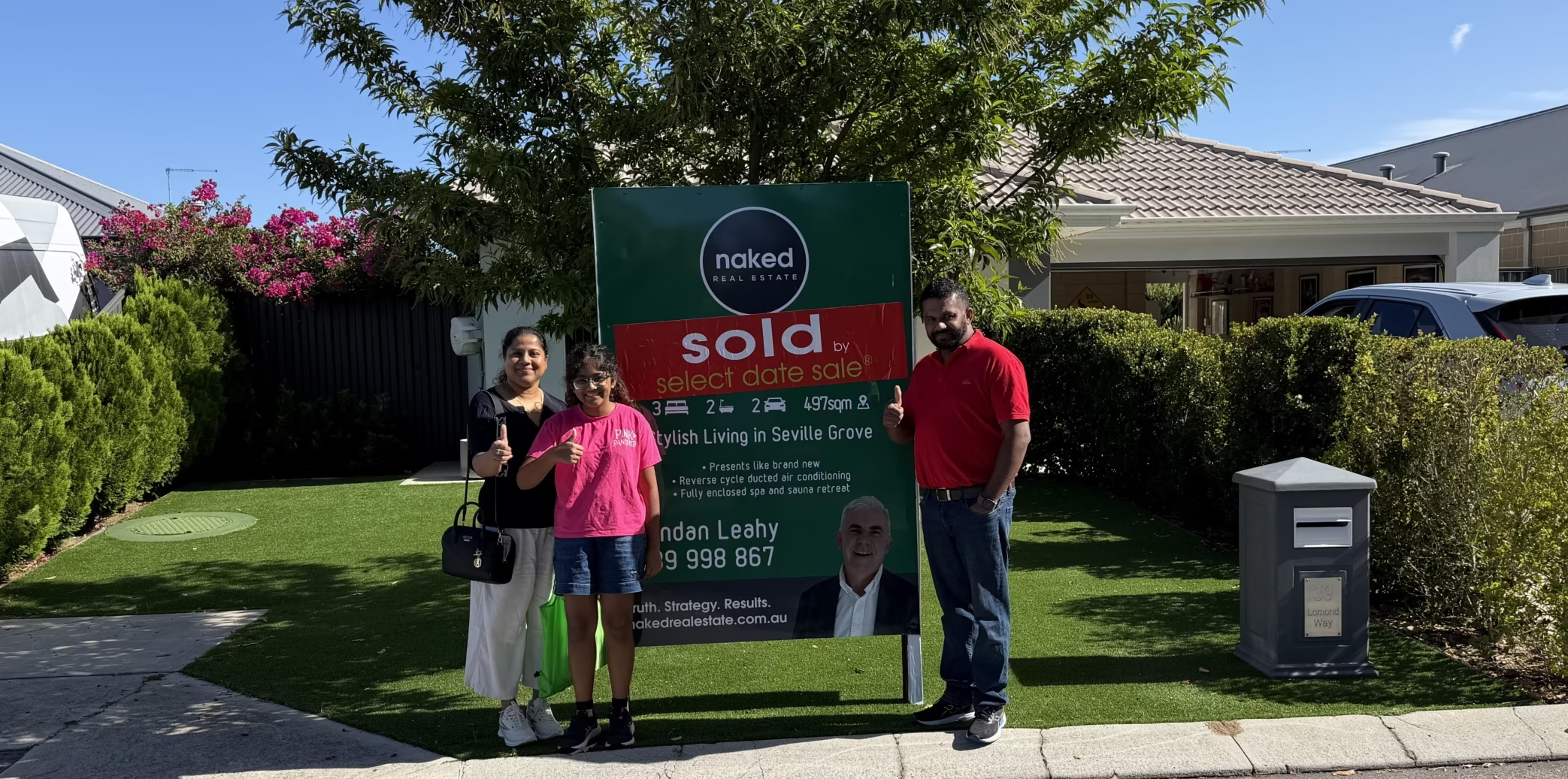
Seville Grove — $81,000 above the offer the owner was ready to accept. The owner would have been happy anywhere in the $750,000–$800,000 range. Through the campaign we drew offers of $792,000, then $805,000, then $826,000. The owner was ready to sign at $826,000 — and most agents would have closed it right there and banked the commission. I held off for one more buyer who was waiting on his bank. Forty-eight hours later that buyer came in at $907,000. That’s $81,000 more than the seller was about to accept. The fee was irrelevant next to that number.

The $2.6 million sale that nearly fell over — and why it didn’t. During Covid I sold a home for $2.6 million in an area where the median was around $780,000. The buyer’s purchase depended on a chain — they had to sell their own $1.2 million property first, and their buyer was a self-employed truck driver waiting on a tax return to get finance across the line. Then the $2.6 million buyer hit family problems and tried to pull out entirely.

That deal didn’t collapse for one reason: the contract was watertight before any of it happened. I’d already had a finance variation pre-signed, and the conditions were written so the buyer would have forfeited a substantial deposit if they walked. I worked it through Christmas and New Year, kept the buyer calm, and got it to settlement — and my seller barely felt the stress, because that’s my job to absorb, not theirs.

Which brings me to the biggest myth in this business.

Does a fast house sale mean the agent did less work?

No — usually the opposite. In my experience, around 60% of the real work in a sale starts after the contract is signed, in the stretch between acceptance and settlement. That’s where dozens of small things can quietly go wrong and sink the deal. A fast sale doesn’t mean the job’s done — it means the hard part is just beginning.

If your home sells in a few days, plenty of people assume the agent got lucky and didn’t earn the commission. Handle that stretch between acceptance and settlement wrong, though, and the deal dies — and you’re back on the market with a “sold and fell over” stamp on your listing.

This is where experience earns its keep, and it’s the part most agents never properly train on.

Every sale in WA runs on the Joint Form of General Conditions for the Sale of Land — the standard contract published jointly by REIWA and the Law Society of Western Australia —together with the Offer and Acceptance. Inside that, it’s the special conditions and the actions attached to an offer that make or break a settlement. We spend serious time staying current on this, including recent court outcomes that change how things should be written, because the rules genuinely move. WA changed its plumbing regulations in February 2024, for instance — what counts as a “fixture,” and who’s even allowed to touch certain work, isn’t fixed in stone.

The skill is in how the conditions are written. A couple of examples from our own contracts:

  • Garden reticulation. We specifically exclude it. Here’s why: come the final inspection, I’d turn the reticulation on and one sprinkler head wouldn’t fire — a $3 part — and that tiny thing could hold up an entire settlement. So we take it off the table in writing from the start.
  • Alarm systems. Half the time people haven’t armed the alarm in years, can’t remember the code, or the backup battery is flat — a $50–$60 fix. The system might be perfectly fine, but nobody can prove it on the day. So we exclude it, plainly, in the contract.

None of that is about cutting corners. It’s the opposite. It’s spelling out exactly where everyone stands before anyone’s stressed, so there are no surprises and no arguments at final inspection. That’s what you’re actually paying a commission for — not the “for sale” sign, the settlement.

What questions should you ask before hiring an agent?

Before you sign with anyone, ask these five questions — the answers tell you far more about an agent than their fee does:

1. How many homes did you personally sell last year? Volume tells you whether they’re experienced or desperate.
2. What’s your average sale price compared to the asking price? Ask for the actual numbers.
3. What’s your strategy to create competition between buyers? “We’ll put it online” is not a strategy.
4. Is the marketing marked up, and who carries the cost? You want it passed through at cost, paid by you — for the conflict-of-interest reason above.
5. What happens between contract and settlement if something goes wrong? Listen for whether they actually understand the General Conditions, or just hand you a form.

My guarantee

When a seller comes to me with a cheaper quote from another agent, I don’t argue about the fee. I put it in writing: if I don’t achieve a price you’re genuinely happy with, I’ll do the job at the cheaper fee.

I can say that because I back myself. An agent who’s confident in the result doesn’t need to win you on price.

The bottom line

I’m a bit of a Formula One buff. There are twenty drivers on the grid and every one of them is good — you don’t get there otherwise. But only two or three are great, and those are the ones who keep winning the championship, year after year.

Real estate works exactly the same way. There are plenty of good and average agents. The thing to be sure of, before you sign anything, is that you’ve got a great one — because over the life of a sale, that’s the difference measured in tens of thousands of dollars, not a fraction of a percent on the fee.

Don’t shop for the cheapest car. Back the driver who wins.

If you’d like an honest appraisal and a straight conversation about what your home is really worth — and exactly what you’d walk away with — call the office or get in touch directly. No pressure, no padding.

Truth. Strategy. Sold.

What Factors Actually Affect Your Property’s Appraisal Value?

Yesterday I walked into a home in Bedfordale.

The automated valuation system — the one most homeowners check online before they make any decision — said the property was worth somewhere between $1.2 million and $1.3 million.

By the time I’d finished my appraisal, the figure I gave the owners was $1.8 million to $2 million.

That’s not a small gap. That’s not “the algorithm was a bit off.” That’s the algorithm being wrong by roughly half a million dollars on a single home.

And it happens all the time.

After more than two decades of selling property across the Perth Hills — Bedfordale, Roleystone, Kelmscott, Mount Nasura, Mount Richon, Seville Grove — I can tell you the question I get asked most often is some version of: “What’s my home really worth?”

The honest answer is that there is no single number. Your property’s value is the result of a long list of factors, most of which the algorithms can’t see, most of which sellers don’t know to look at, and most of which the average agent won’t tell you about.

This article is about those factors. The ones that actually move the price up or down. The ones that determine whether you walk away with what your home is genuinely worth, or whether you leave six figures on the table.

It’s also about something most sellers never think about — the difference between an appraisal that flatters you and an appraisal that’s honest with you. Because at the end of every campaign, only one of those leads to the right outcome.

Let’s get into it.

What Actually Happens in the First 60 Seconds of an Appraisal

Most articles on this topic say agents look at “comparable sales” or “land size” first. That’s not what happens.

The appraisal starts before I even get out of the car.

I drive up to the home and look at the street appeal. Has the front been maintained? What does the roof look like — do the tiles need work, is the ridge capping cracked, are the gutters rusted? Has it been freshly painted recently or is the paint tired? Have the eaves
gone mouldy? These things are visible from the road and they tell me an enormous amount about the property before I’ve even walked through the door.

Then I step inside, and I’m going to be honest with you here because most agents won’t. The first thing I’m doing is asking whether the home smells.

It sounds funny, but you would be surprised how often this matters. People with pets, or people whose cooking habits involve a lot of certain spices, or households where things just haven’t been aired out properly — they don’t notice it anymore because they live there. But a buyer walking in for the first time absolutely notices, and most agents won’t tell you because they’re too frightened of offending you.

My job is to actually get you to a point where we can sell your home for the best possible price. Sometimes a blunt conversation right at the start is the difference between a good price and a great price. And there is a difference.

From there I’m looking at presentation. Is the house tired? Does it need a fresh coat of paint? Are lightbulbs missing? Is there clutter everywhere? How do the bathrooms and kitchen look — not whether they’re new, but whether they’re functional and clean? Are there small jobs around the place that have been left undone?

Every one of those things affects price. And every one of those things is fixable, often cheaply, if the owner is willing to do the work.
The price I’ll quote you depends partly on what you’re willing to address before we go to market — because once buyers see a home online, you don’t get a second chance at the first impression.

Why the Online Algorithms Get It So Wrong

Let’s go back to that Bedfordale home from yesterday.

The automated valuation system gave a figure between $1.2 and $1.3 million. My appraisal was $1.8 to $2 million. What did the algorithm miss?

A lot.

The square meterage was wrong on the system to start with. That’s not unusual — these systems pull from old council records or guess based on land size, and they get it wrong constantly. From there it just compounded:

The home had a wonderful three-phase powered workshop — significant value to the right buyer, completely invisible to an algorithm.

It had a beautiful playground-style pool, well presented and maintained.

It had views across public open space, down the valley, all the way to the coast. Algorithms can’t see views.

The kitchen was enormous — well beyond what you’d expect at that price point. Algorithms count rooms, not size or quality.

And the overall presentation was spot on. Light, bright, clean, well looked after. That doesn’t show up in any database.

This is why I tell every homeowner the same thing: an online estimate is a starting point at best, and a dangerous trap at worst. The algorithms work by averaging sales of nearby properties with similar bedrooms, bathrooms, and land size. They have no idea whether your home backs onto public open space or onto a busy road. They don’t know your kitchen was renovated three years ago. They don’t know whether the property is dead flat or sits on a steep slope that would cost a fortune to develop. They don’t know whether mains water is connected to your acreage block, which is rare in this area and matters enormously.

These tools can be 10%, 20%, sometimes 50% out either way. And the people who get hurt by that are the people who plan their next move based on those numbers.

Why Most Sellers Get Their Own Price Wrong

Here’s something I see constantly, and it’s worth being direct about because nobody else will tell you.

Most sellers who overprice their home aren’t doing it because they don’t understand the market. They’re doing it because they’re not looking at the home from a buyer’s point of view. They’re looking at it from the point of view of what they want to buy next.

They’ve worked out their budget. They’ve decided they want to move closer to the coast, or to a nicer suburb, or to a bigger home. To make that move work, they need, say, $1.5 million. So now in their head, $1.5 million is what their home is worth — because that’s what they need it to be.

Then friends come around and say “It’s an absolutely beautiful home, don’t let the real estate agent undersell you, stick to your price.” That’s not strategy. That’s hope. And hope has never been a strategy in real estate.

It gets worse from there. They go online and the automated valuation conveniently agrees with the number they want. Or they start looking at bridging finance, and if they’re borrowing less than 70% LVR, the bank will do a “desktop valuation” — basically taking the
agent’s word or the algorithm’s number and rubber-stamping it. At 50% LVR, the bank will tell them just about anything they want to hear to put the finance in place.

So now they’re emotionally and financially locked in to a price that has nothing to do with what their home is actually worth in the market. Here’s the hard truth: the real estate agent isn’t buying your home. The seller isn’t buying your home. The buyers are buying your home.

And if you list at a price the market won’t pay, what happens is you help every other home in the area sell before yours does. Buyers compare yours to what else is available, and they walk away saying “the one down the road is better value than this one.” That’s the most
painful way to spend a year trying to sell.

What Buyers Are Actually Doing in Their Heads

This part is going to be different from anything you’ve read elsewhere on property valuation, but stay with me, because it’s the most important section of this article.

What a buyer pays for your home has almost nothing to do with logic.
There are three parts of the human brain involved, and they work in this order:

The reptilian brain — the safety check.

When a buyer walks into a home, the very first thing happening is a primitive question: do I feel safe here? Could my family be safe here? Is there anything threatening about the space?

Most buyers walk into the kitchen first. They stand there. And in those first seconds, they’re making a fight-or-flight assessment of whether this is somewhere they could imagine themselves living. If the answer is no — for any reason, even reasons they can’t articulate — they’ve already made up their mind. They might walk through the rest of the house politely, but they’re not buying.

This is why presentation matters so much. A cluttered, dark, smelly, neglected home triggers the wrong response in the wrong part of the brain, and you’ve lost the buyer before they’ve even seen the bedrooms.

The mid-brain — hierarchy and prestige.

Once safety is established, the next layer kicks in. Can I see myself entertaining friends here? Is this the kind of home I’d want people to see me in?

This is the buyer mentally placing a barbecue on the deck, picturing friends arriving, imagining the comments they’d hear. “What a beautiful home. Imagine living up here in the hills.” If your home can let them rehearse that conversation in their head, you’re in the
buying zone.

The neocortex — justification after the sale.

This is the third stage, and it’s where most real estate agents get the whole process backwards.

The neocortex is the logical brain, and it gets activated only AFTER the buyer has decided emotionally to buy. Once friends start asking “you paid how much?”, the buyer needs justification — the playground pool, the workshop, the kitchen, the ducted air-conditioning, the walk-in robe, the ensuite.

A huge amount of real estate marketing is aimed at the neocortex — bullet lists of features, technical specifications, room dimensions. That stuff is for justification AFTER the sale, not for triggering the sale itself. Agents who lead their marketing with feature lists are talking to
the wrong part of the brain entirely.

The sale happens at the reptilian and mid-brain level. The features close it out. One more observation, and I’ll say it carefully because the point matters more than the framing: the buying decision in most family homes is heavily influenced by the woman in the household. And in my experience, women tend to put themselves last. They walk the home in this order: kitchen first, then the children’s bedrooms and bathroom, then the laundry, and finally — almost as an afterthought — the master bedroom.

Then outside, looking at the workshop, the pool, the space for kids, the lifestyle features. If your home doesn’t work for the family at those three checkpoints, the features list at the end won’t save it. And if the agent doesn’t understand any of this, they’re guessing.

The Truth About Renovations and Return on Investment

This came up yesterday at that same Bedfordale appraisal. The owners asked me whether they should put in a third bathroom upstairs, off a teenage retreat.

My answer is the rule I give every seller: if you’re going to stay in the home for the next 5 to 10 years and you’re going to use the third bathroom, then yes, build it. Get value out of it yourself.

If you’re going to be selling in the next 12 to 18 months, don’t bother. A bathroom build is going to cost you at least $30,000 and you won’t get extra money for it at sale.

The same logic applies to most major renovations. Expensive bathrooms and kitchens, swimming pools — if you’re about to sell, these are usually money pits. You won’t recover what you spend.

There’s one caveat: if your bathrooms or kitchen are so rundown that a buyer would need to renovate them immediately, then they ARE costing you money — because buyers are mentally subtracting the cost of those renovations from what they’d pay for the home. In that case, doing something is better than doing nothing. But if your bathrooms and kitchen are functional and clean, leave them alone.

So what should you actually spend money on before selling?

Paint. Dollar for dollar, fresh paint is the cheapest and highest-impact thing you can do. It lifts a tired home faster than anything else.

Lighting. The old fittings in most homes make them look darker. A pack of 10 downlights from Bunnings and an electrician to install them — maybe $1,000 total — will make your home feel modern, bright, and warm throughout. The difference is immediate.

Flooring. Not always essential, but if floors are worn or dated, replacing them isn’t always expensive and can dramatically lift the feel of the home.

Decluttering. This costs nothing and changes everything.
If your home is small and you don’t have a shed or garage to store excess belongings, take the smallest bedroom and turn it into a temporary storage room. We don’t need to photograph that room. Buyers understand — most of them are in exactly the same situation
when they move. Decluttering is the single most underrated thing a seller can do. It makes rooms feel bigger, lighter, and easier to imagine living in. And it costs you nothing but time.

Location Within the Suburb Matters More Than Most People Realise

Every property article you’ve ever read will tell you “location, location, location.” But almost none of them explain what that actually means at a street level.

A suburb isn’t one homogeneous market. It’s multiple markets sitting next to each other, often with significant price differences.

Let me give you two real examples from suburbs I work in every day.

Bedfordale. On the Wallangara side, you can have a 4-bedroom, 2-bathroom home on 2 to 3 acres that’s worth around $1.4 million. Cross Albany Highway to the newer estates — Churchman Brook Estate or Waterwheel Ridge — and the same 4×2 layout on a 3,000 to
4,000 square metre block is worth around $1.8 million.

Same number of bedrooms. Same number of bathrooms. Smaller block of land. Higher price. Why? Because the newer estates have different infrastructure, scheme water, different buyer demographics, easier access. The Wallangara side is acreage with bore water and a
different lifestyle entirely. They’re different markets, and buyers approach them differently.

Mount Nasura. A 4-bedroom home at the bottom end of the suburb, near Albany Highway, will sell for around $1 million. Move that same home to the top of Mount Nasura — Rushton Terrace, Blackwood Drive — and it’s worth around $1.5 to $1.6 million. Same home. Different street. $500,000 difference.

This is why an algorithm averaging sales across “Mount Nasura” or “Bedfordale” will get it badly wrong on either side of the spectrum. The data points exist, but the algorithm treats them as one market when they’re really four or five.

A local specialist knows which pocket of the suburb your home sits in, which buyers are likely to be looking there, and what genuine comparable sales actually apply to your property. That’s the part you can’t get from a website.

What Happens When You Overprice — and Why “Negotiating
Down” Is a Trap

Sellers and a lot of agents think that listing high gives “room to negotiate down.” Here’s what actually happens.

The rule of thumb in real estate is that if you’re not within 5% of where the market deems your property to be priced, you’ll get very few enquiries — and if you’re 15 to 20% over the market, you’ll get almost no genuine offers.

Yes, you’ll hear stories about someone who got lucky and an over-market price stuck. But luck isn’t a strategy. 99.9% of the time, the over-priced home sits. So 30 to 40 days in, the agent suggests a price reduction. Let’s say 5%. Now you’re only 10-15% over the market. Same problem. The market knows you’ve adjusted, so they’re
watching you, but you’re still not in the buying zone. The reports that good agents can show you will tell you how many buyers have saved your property on portal websites — a strong signal that they like the home but don’t see the value at the current price.

Another three or four weeks pass. You’re at 60 days. You drop the price again.

Now everyone’s seen the home online for two months. There are websites — old-listings- style tracking services — that record listing history. Buyers actively use them to identify aged listings and negotiate harder, because they know how long you’ve been on the market.

And then there’s the negotiation trap. If your “strategy” was to list high and negotiate down, what you’re actually doing is negotiating with one buyer in isolation, with no competition from other buyers.

Here’s how it typically plays out:
You’re asking $1.2 million
The buyer offers $1 million
You meet in the middle at $1.1 million
They counter $1.05 million
You meet at $1.025 million

Each round halves your position. That’s a brutal way to sell a home — and it doesn’t account for the stress, the time, the months of keeping the home immaculate for inspections, th disruption to family life.
It gets worse in a declining market. If you’ve been on the market for 60 to 90 days and prices have dropped another 5%, you now probably have to drop a further 10% below true market value just to get people interested again. Overpricing in a falling market doesn’t just delay your sale — it compounds your losses.

The lesson is simple. The first 30 days of a campaign are when your property is freshest, most-watched, and most able to generate genuine competition. Waste them at the wrong price and you can’t get them back.

Marketing — and What 10-15% Looks Like in Real Money

How much of the final sale price is driven by HOW the home is marketed, versus WHAT the home actually is?

Honest answer: if your agent doesn’t understand the rules around marketing, or thinks marketing is a waste of money and a few iPhone photos thrown online will do the job, you’re going to leave 10 to 15% of your home’s value on the table. At minimum.

On a $1.2 million home, that’s $120,000 to $180,000. On a $1.8 million home, it’s $180,000 to $270,000. That’s not small money. That’s family-changing money. Here’s why. Almost every buyer in 2026 starts their search online, and the first thing they do is compare your home to every other home for sale in your suburb. If your photos are bad — dark, grainy, badly framed — they scroll past in under three seconds.

You don’t walk into a beautiful hotel or a new display home and find the lights switched off. The same logic applies to your home when you’re selling. It needs to be light and bright in every single photo.
The biggest thing most sellers miss is video. A proper video walkthrough — with the agent describing what the home is like and what makes it special — does what photos can’t. It lets buyers experience the home before they ever step inside.

The other thing most sellers don’t think about is the floor plan. Not a photocopy of something thrown together on the agent’s iPad. A properly drawn floor plan that shows bedrooms with furniture in them, living areas with sofas, the family room with the TV in
place.

Why does this matter? Because I’ve personally listened to buyers walk through a home with a good floor plan brochure and say “Mary can have this bedroom, John can have this one. We could put the wall unit here. The TV can go over there.”

That buyer has just bought the house. They’ve placed their belongings in it mentally. Everything from that point is just bringing the deal together. The brochure itself should be on cardboard, not paper run off the agent’s inkjet at home. When buyers walk away with a quality brochure, the home stays with them.

Miss these elements and you don’t get maximum competition between buyers. And here is the line every seller should remember:
You don’t get the best price for your home in isolation. You get it with competition between buyers wanting your home.

That’s the entire job of marketing. Not to “expose” your home to the market. To create competition between buyers who want it.

The Hardest Truth — Choosing Your Agent

I’m going to be direct with you here because this is the part where most sellers get it wrong.

In Western Australia, becoming a registered real estate representative takes an 8 to 10 day course. That’s it. After 8-10 days, someone is qualified to sell your family home — your biggest financial asset — and most offices then hand them a desk and a phone and say “good luck.”

Of the 1,800 to 2,000 agents trained in WA each year, only about 5 are still in the industry by the end of Year 1. After 5 years, only 2 or 3 of those are left. This is a hard business if you’re not willing to keep working at it.

So the real question isn’t whether your agent is registered. It’s whether they’re any good.

And here’s a brutal truth that sellers don’t hear often enough: there’s a big difference between “20 years of real estate experience” and “1 year of experience repeated 20 times.”

Plenty of agents got their registration, learned the basics in their first 12 months, and have done no real training since. They’re not better than the 5-year agent who’s been studying their craft. They’re just older.

The psychology and the emotional side of real estate — the three-brain stuff we talked about, the buyer behaviour, the negotiation skills — these are things any decent agent should be trained in. Not “maybe if I have time.” Must.

I still train every morning. I’m reading something or listening to something that makes me sharper, gives me an edge in the marketplace, helps me get my clients a better price. The day I stop doing that is the day my clients start losing money. Most sellers pick the agent who quotes them the highest price. That’s the single most expensive mistake you can make. Because the agent who told you what you wanted to hear at the appraisal is the same agent who’ll be sitting in front of you in 90 days, telling you to drop your price because “the market has changed.”

Before you choose an agent, ask each one these questions and compare the answers carefully:

1. What evidence are you using to support your price recommendation? Look for recent comparable sales, active competition, buyer enquiry levels, real market data — not opinions.

2. How will your strategy create competition between buyers? Exposure alone doesn’t create premium prices. Competition does.

3. How many of your recent listings have actually sold using the method you’re recommending for my property?

4. If your recommended price or strategy doesn’t work, what’s the plan?

5. What do you think buyers will dislike about my property — and what’s your plan to overcome those objections?

6. If this was your own home, would you use the same strategy you’re recommending to me? The answer should be immediate and confident.

7. What happens if the first two weeks don’t go to plan? Ask for a specific answer, not a vague one. The first two weeks are critical.

8. What is the biggest mistake sellers are making in today’s market? This reveals how well the agent understands current conditions.

9. What are you going to do differently that could help me achieve a better result than other agents? Look for a genuine strategy, not promises about photos, advertising, or company size.

10. What training have you done recently — and who have you been mentored by — to keep improving your craft?

The best agents focus on your outcome. Not their awards. Not their office size. Not their personal brand. Your outcome.

And ask yourself this question — the one that matters more than any of the others: Is this the person I want sitting in front of me at the final negotiation, telling me this is the most I’m going to get for my home?

If you can’t trust that they’ll tell you the truth at that moment — the moment that decides everything — then don’t pick them. It’s that simple.

Friendliness is not a substitute for capability. Likability is not a substitute for honesty. The agent who tells you only what you want to hear at the appraisal is the same agent who’ll fail you at the negotiation.

The Bottom Line

Your property’s appraisal value isn’t a single number that comes out of a database. It’s the product of dozens of factors — many of which the algorithms can’t see, most of which the average agent won’t talk about honestly, and all of which add up to either the right outcome or six figures left on the table.

The street appeal. The smell. The presentation. The renovations you do or don’t do. Which pocket of the suburb you sit in. The pricing strategy you choose. The marketing investment.

The buyer psychology you trigger or fail to trigger. The agent you choose to handle all of it.

Every one of those things either adds to your price or takes from it.
If you take one thing away from this article, take this: You don’t get the best price for your home in isolation. You get it with competition between buyers wanting your home. Everything else — the appraisal, the presentation, the marketing, the strategy, the agent you choose — is in service of building that competition.

And the agent you trust to build it for you is the one who’ll be sitting opposite you at the end, telling you the truth about the offer in front of you. Pick the one you trust to do that.

If you’re thinking about selling in Bedfordale, Roleystone, Kelmscott, Mount Nasura, Mount Richon or Seville Grove, I’d be happy to come and give you an honest appraisal. No pressure, no obligation, no game-playing.

Just a real conversation about what your home is genuinely worth in today’s market, and what we’d do to maximise it.

Call the office on 08 6254 6333, or contact me directly on 0439 998 867.

Truth. Strategy. Sold.

Do I Need an Appraisal to Refinance My Mortgage?

You’ve been in your home ten years. You’ve never really kept track of what it’s worth, but you’ve seen a few places sell down the road and you reckon you’re sitting on around $1.2 million. Interest rates, a renovation, consolidating some debt, helping the kids — whatever the reason, you’re thinking about refinancing.

So do you actually need an appraisal before you refinance? And if the bank does its own valuation anyway, why would you bother getting a real estate agent involved first?

After more than two decades selling homes across the Perth Hills, here’s my honest answer: getting an agent appraisal before you refinance costs you nothing, takes 15-30 minutes, and can save you from a mistake that follows you around for five years. Let me explain why.

First, Understand the Three Types of Valuation

Most homeowners don’t realise there are three completely different types of property valuation, and they get used for different things.

1. The bank’s AVM or desktop valuation. This is an automated valuation — the bank’s valuer uses a computer system and doesn’t physically visit your home. Banks typically use this when you’re borrowing at a lower loan-to-value ratio (under around 70-80%), where their risk is lower.

2. The full licensed valuation. This is ordered by the bank after you submit your finance application. A licensed valuer physically attends your property. This is the valuation banks and courts must use — they’re required to under the rules set by APRA (the Australian Prudential Regulation Authority). It’s the official, legally recognised figure.

3. The real estate agent market appraisal. This is what I do. It is NOT a licensed valuation — real estate agents legally cannot provide those, because we don’t fall under APRA. What an agent appraisal gives you is an informed, experienced read on where your property sits in the current market. It’s the starting point that helps you, and your finance broker, understand your position before you go anywhere near a bank.

The process usually flows like this: you get an agent appraisal to understand your value, your broker uses that to build your application, the application goes to the bank, and then the bank orders its own full licensed valuation.

Here’s the part most people don’t expect.

Why the Bank’s Valuation Almost Always Comes in Lower

When I appraise a property before someone refinances, I always tell them the same thing: the licensed valuation that the bank orders will usually come in lower than my figure. Often 10-15% lower. Sometimes more.

This isn’t because I’m inflating the number or the valuer is being difficult. It’s because the licensed valuation is answering a completely different question.

My appraisal answers: “What could this property realistically sell for on the open market?”

The bank’s licensed valuation answers: “If this borrower defaults and we have to repossess and sell quickly, what’s the safe figure we could recover?”

Those are two different numbers for two different purposes. To put it bluntly, the licensed valuation is the bank covering itself.

Here’s a worked example. Say your home is worth $1 million on the open market and you want to borrow 90% — that’s a $900,000 loan. If the bank ever had to repossess and sell, they don’t need to chase the full $1 million the way you would. They only need to recover $900,000 to cover what they lent. A conservative valuation protects that position and means their lenders mortgage insurance doesn’t need to be claimed.

So when your bank valuation comes back lower than you hoped, it doesn’t necessarily mean your home isn’t worth what you thought. It means the bank was never trying to tell you your market value in the first place.

The Five-Year Mistake Most People Don’t See Coming

Here’s the warning that matters most, and the reason I tell people to get an appraisal before they apply, not after.

The bank only does its valuation AFTER you submit your finance application — because the bank pays for it, so they won’t order one before you’re actually in the process. That means if you go in with a wrong idea of your value, you can find out the hard way.

If your application gets knocked back — because your loan-to-value ratio was too high, or because your home was worth less than you assumed — that declined application lands on your credit reference report. And it stays there for five years.

Every future lender who looks at your file will see that you applied for finance and were declined. It reduces your credit score and it affects your ability to borrow down the track. One rushed application built on a guess can damage your borrowing position for half a decade.

That’s why the free, no-risk first step — getting an agent in to tell you where you really sit matters so much.

A Real Example: The Client Who Called Too Late

Late last year, a client called me in — but only after it was already too late.

They’d applied for additional finance to help their business. The valuation on their property came back lower than they expected. At the same time, their business had hit a downturn, which reduced their borrowing capacity. The low valuation pushed them to a 97% loan-to- value ratio, and the bank ended up asking them to pay down part of the loan.

That’s when they called me — to see what could be done about the low valuation.

Unfortunately, by that point there was almost nothing I could do. Once a licensed valuation is completed, it is extremely difficult to get the number changed. In my entire career, I think I’ve only ever managed to get a valuation revised twice. Once it’s done, it’s effectively fina — as far as both the valuation company and the bank are concerned.

Here’s the thing that still bothers me about that case: if they’d called me BEFORE they put in the application and triggered the licensed valuation, we could have sat down and talked through their circumstances and the real value of the property. Given the business downturn and the tight numbers, the best advice might well have been not to approach that bank at all, and to look at an alternative instead.

That’s the real value of a pre-application conversation. It’s not just about getting a number. It’s about working out whether you should even be making the application in the first place — before it hits your credit file, before the valuation locks in, before the bank can demand a paydown.

What a Proper Pre-Refinance Appraisal Actually Involves

When I come out to appraise a property before a refinance, you should expect a full appraisal pack — genuine knowledge of the suburb, recent comparable sales, and what’s currently on the market. You should also get practical advice on simple things you can do to improve your position.

And here’s a tip that costs you nothing: declutter and give the house a good clean before the valuer comes out.

It sounds trivial, but it genuinely matters. The licensed valuer is a human being. If they walk into a property that’s a mess and poorly kept, they note it in their system, and it affects the figure. Why? Because they’re assessing whether the property is in a sellable state on the day they look at it — remember, they’re thinking about whether the bank could sell it if you defaulted. A property that presents poorly gets marked down.

One more honest point: it’s handy to give the valuer what your local agent has appraised the property at — and they’ll record it on the valuation form. But understand the valuer can only go off the sales evidence they produce themselves. They legally cannot be influenced by outside parties. So the agent figure is useful context, not leverage.

The Biggest Misconception: Trusting the Online Number

The most common mistake I see is homeowners building their refinance plans around an online valuation.

They go to a home open or two, browse a few comparable properties online, or run their address through an automated valuation system. The AVM tells them their property is worth $1.2 million. Then the licensed valuation comes in at $900,000 — and their whole plan falls apart.

The gap exists because automated systems can’t see the things that actually drive your home’s value: whether the property is connected to scheme water, whether it’s subdividable, whether it has valley views, Hills views, or a city outlook, whether the block slopes or is level, whether it has side access for a workshop, a swimming pool, reverse-cycle ducted air-conditioning, or built-in robes. All of these make a marked difference to price, and none of them appear in the algorithm.

I’ve written a whole separate article on exactly how unreliable online valuations can be and why — it’s worth a read if you want to understand the detail before you refinance.

The danger in a refinance is specific: if you build your borrowing plan around an inflated online figure, you’ll assume you have more equity than you actually do. Then the real valuation comes in lower, your LVR is higher than expected, and you’re staring down the credit-file and loan-paydown problems we’ve already talked about.

Things to Be Careful About Before You Refinance

The advice above applies no matter why you’re refinancing. But there are some specific traps worth knowing about.

Watch your loan-to-value ratio and stress-test it. Don’t borrow to a level that only works at today’s interest rates. Ask yourself: if rates went up half a percent or one percent, could you still cover the repayments? Borrow with that headroom in mind.

Be careful rolling short-term debt into your mortgage. Consolidating loans into one repayment can be a good move — but only if you’re disciplined and don’t go out and buy more toys with the freed-up cash. And think about the timeframe. A boat, caravan, car or motorbike would normally be financed over four or five years. Roll it into your mortgage and you could be paying it off over the 20 years left on your home loan — paying interest the whole time. That adds up to far more than you’d expect. Have a play with the mortgage calculator on our website to see exactly what adding that debt does to your repayments and total interest.

Think hard about extending your loan term. People often refinance a mortgage with 15 years left back out to 25 or 30 years. It can substantially reduce your monthly repayments — but it also adds an enormous amount of interest and years to the day you finally own your home outright. It’s a genuine trade-off. Talk it through properly with a finance broker or your bank.

Choose your broker carefully. Just like real estate, there are good brokers and bad brokers. Some will write you a new loan as fast as they can blink, because they earn a substantial commission on every loan written — and some will come back every two or three years to refinance you again for another commission. Plenty of brokers would never do this, and I know some excellent ones. Just be aware it happens. Sadly, I sometimes see the end result: a client calls me because they’ve been put in a position where they now have to sell before the bank repossesses.

Be especially careful in a separation. I’ve seen couples split amicably, agree to a 50-50 division based on an online valuation, and get badly caught out. A year later, the person who kept the house goes to sell and finds it’s worth less than the figure used in the settlement — or the person who moved out discovers the home sold for $150,000 to $200,000 more than they were paid out against. By then it’s too late. In any separation, get a proper licensed valuation and proper legal advice — don’t divide your biggest asset based on a computer estimate.

Your Step-by-Step Roadmap

If you’re thinking about refinancing, here’s the sequence I’d recommend:

1. Get clear on why you’re refinancing and whether it genuinely improves your position 2. Understand the true long-term cost — use a mortgage calculator to model the real impact

3. Get an agent appraisal so you know your actual value before you commit to anything

4. Talk to a good finance broker or your bank about your options

5. Then, and only then, submit your application — with realistic numbers and no nasty surprises

Don’t rush. Don’t over-borrow. And don’t let anyone push you into a loan that benefits them more than it benefits you.

The Bottom Line

For simplicity’s sake, your first port of call should be to get an agent in — just so you get a lie of the land before you make any decisions. It costs you nothing.

That one free conversation can tell you whether your refinance plan is realistic, protect you from an application that damages your credit file, and stop you from making a decision you can’t undo.

Thinking About Refinancing? Let’s Talk First.

If you’re considering refinancing and you want an honest read on what your property is genuinely worth in today’s market — give us a call, send an email, or drop a text.

We’ll come out, have a look, and give you a clear picture before you make any decisions. No pressure, no obligation. It doesn’t matter if you’re refinancing next month, next year, or just weighing it up — that’s what we’re here for.

Brendan Leahy, Naked Real Estate
08 6254 6333
brendan@nakedrealestate.com.au
Unit 1/198 Brookton Highway,
Kelmscott WA 6111

Truth. Strategy. Sold.

Disclaimer: Brendan Leahy and Naked Real Estate are not licensed valuers, mortgage brokers, or financial advisors. This article is general information based on experience in the local property market, not financial or legal advice. Always speak to your finance broker, lender, accountant, or solicitor before making refinancing decisions.

Sell Your Home for More with these FIVE Updates

There are two ways sellers leave money on the table:

1. They list the home as-is (under-prepared), or
2. They over-capitalise on renovations the market won’t pay for.

Both cost you. The sharp move is the middle ground — five low-cost, high-impact updates that consistently lift a Perth Hills home’s sale price without blowing the budget or delaying your campaign.

Here they are.

1. Paint the interior in neutral tones

The cheapest, highest-impact update you can make. Fresh paint says “this home has been cared for.” It also brightens the space, which matters more in Perth Hills homes where established trees and elevation can make interiors feel darker than they really are.

Stick to: warm neutrals — off-whites, soft greys, pale beiges.

Avoid: strong feature walls, trendy colours that date quickly, anything you personally love but the market won’t.

Approximate cost: $2,000–$5,000 for a professional interior repaint depending on size. One of the highest-returning preparation investments you can make.

2. Declutter and depersonalise

This one is free. Most sellers skip it because it’s emotionally hard.

Buyers need to picture themselves living in your home. They can’t do that when every shelf is covered in your family photos, your trophies, your kids’ artwork, or your collection of anything. Pack it.

Rule of thumb: remove half of everything visible. Empty surfaces. Empty walls. Empty wardrobes — buyers will look inside, and full wardrobes signal a lack of storage.

The home should feel like a hotel-staged version of itself, not a lived-in family scrapbook.

Approximate cost: $0. If you don’t have somewhere to put it, hire a small storage unit for the campaign — usually $50–$100 a week.

3. Sort the kerb appeal

Buyers form an opinion within seconds of pulling up. If the front of your home is tired, you’re climbing a hill before they walk through the door.

Quick wins:

– Mow, edge and weed
– Mulch the garden beds
– Paint or replace the front door
– New letterbox if the existing one is faded
– Pressure-wash the driveway and front path
– Add two large pots with healthy plants by the front door
– Clean the windows inside and out

Approximate cost: $500–$2,000. Returns far more than that on sale day.

4. Minor kitchen refresh — NOT a renovation

This is where sellers most often over-capitalise. A full kitchen renovation rarely returns more than it costs at sale.

What works:

– Replace cupboard handles
– Refresh the splashback if it’s dated
– Replace the tapware if it’s tired
– A coat of paint on tired cupboards
– Deep-clean the oven, rangehood and benches

Approximate cost: $1,000–$4,000 for the whole refresh.

Do NOT rip out and replace the kitchen unless it’s genuinely unusable. The maths almost never works in the seller’s favour.

5. Modernise the lighting

Old pendant lights and yellow bulbs date a home faster than almost anything else. Walk through your home at night and look up. If the fittings are dated, replace them.

The simplest version: replace every bulb with a modern warm-white LED. Brighter, cleaner, instant lift. A few dollars per bulb.

The next step up: for visible fittings — the pendant over the dining table, the vanity lights in bathrooms, the entry light — invest a bit more. Modern fittings are widely available and disproportionately impactful for the price.

Approximate cost: $200–$1,500 depending on how far you take it.

The trap: over-capitalising

What sellers should NOT do before going to market:

– Full kitchen renovation
– Full bathroom renovation
– New flooring (unless the existing is genuinely unsalvageable)
– Pool installation
– Extensions or additions

These rarely return more than they cost. They also delay your campaign by months. If a buyer wants to renovate, let them — and price the home accordingly.

The point of these five updates is to remove buyer objections, not to add features. Buyers pay a premium for a home that’s presented and move-in ready. They don’t pay extra for someone else’s renovation choices.

The truth about presentation

Presentation matters. So does pricing. So does method.

Naked Real Estate® averaged 14.01% above list price across 79 settled sales in 2025 and has been ranked on the REB Top 50 Agents WA every year from 2022 to 2025. That premium doesn’t come from any single thing — it comes from a defined process that combines correct presentation, sharp pricing, and the trademarked Select Date Sale® method to create competitive tension between qualified buyers.

Updates help. Strategy is what closes.

Truth. Strategy. Sold.


Book an appraisal

Thinking of selling? Book an appraisal with Brendan Leahy at Naked Real Estate® for a frank discussion about what to fix, what to skip, and what your home is genuinely worth in today’s market.

See our full industry recognition for the complete track record.

How To Spot A Dud Agent

The wrong choice of agent can cost you thousands. In a softer market, tens of thousands. In a strong market, you’ll never know how much you left on the table — because the agent won’t tell you, and you won’t ask.

Here are the warning signs to watch for before you sign anything.

 1. They overvalue your home to win the listing

Some agents tell you what you want to hear. They quote a higher figure than the market will support, win the listing, and then “condition” you down once the campaign starts and the offers don’t come in.

By that point, your home has been sitting on the market for weeks. Buyers notice. Days on market kills price.

What to ask: “Can you show me three recent comparable sales — last 90 days, same suburb, same style — that justify this price?” If they can’t show you, the price is fiction.

 2. They quote a fee but not a method

A fee with no method is a transaction. A method is a strategy. If your agent can’t explain HOW they’ll get you the best price — the marketing schedule, the buyer pipeline, the negotiation framework, the date strategy — they’re winging it.

Brendan has been in real estate since 2002 and developed the trademarked Select Date Sale® method specifically because winging it costs sellers money.

3. They can’t speak fluently about your suburb

Test them. Ask street-level questions.

In Mount Nasura, can they explain the difference between Lower Mount Nasura and the Blackwood Drive hillside? In Bedfordale, do they know which streets attract families versus lifestyle buyers? In Kelmscott, can they walk you through the difference between Clifton Hills, central, and the redevelopment pockets?

If they’re vague, they don’t sell there often enough. Suburb medians are not local knowledge. Streets are.

4. Their reviews don’t stack up

Check Google reviews AND RateMyAgent. Both. Plenty of agents game one platform — fewer can sustain both.

A solid baseline I’d recommend looking for: 50+ Google reviews, 100+ RateMyAgent reviews, star rating 4.7 or higher. If the volume is thin or the rating is patchy, ask why.

For reference: Naked Real Estate® currently sits at 4.9★ on Google with 166 reviews and 4.9★ on RateMyAgent with 380 reviews.

5. They’re easy to reach during the courtship, hard to reach after you sign

This is the most common complaint sellers have AFTER they’ve signed. Calls go unreturned. Emails take 48 hours. Open homes happen without a debrief.

Ask their previous clients directly: “How quickly did they get back to you during your campaign?” If they won’t give you references, that’s a flag in itself.

6. They get defensive when asked hard questions

Watch what happens when you push back. A good agent welcomes the challenge — it shows you’re serious. A dud agent gets twitchy, deflects, or starts selling harder.

You’re hiring someone to negotiate hundreds of thousands of dollars on your behalf. If they wilt under questions from you, what happens when a sharp buyer pushes them?

7. They don’t qualify buyers

A dud agent brings every buyer through your home. A good agent qualifies first — finance approved, genuine intent, suburb-locked, realistic about price.

Walking unqualified buyers through your home isn’t service. It’s lazy. It wastes your time and signals desperation when offers don’t follow inspections.

What to ask: “How do you qualify buyers before bringing them through?”

8. They lead with discounts and gimmicks

Free appraisals are standard. But if the pitch is “we’re the cheapest” or “we’ll throw in X for free,” that’s a sign they have nothing else to offer.

Cheap commission usually buys cheap service. And cheap service usually costs you on the sale price.

The maths: a 1% fee saving on a $900,000 home is $9,000. A 2% price gain from a sharper agent is $18,000. The fee isn’t the number that matters.

What good looks like

A good agent:

– Justifies their price with recent comparable sales, not optimism
– Explains their method, not just their fee
– Knows your suburb at street level
– Has stacks of reviews on multiple platforms
– Returns calls and runs proper debriefs
– Welcomes hard questions
– Qualifies buyers before walking them through your home
– Charges what their service is worth and proves the value


The Naked Real Estate difference

Naked Real Estate® has been operating since 2012, founded as Brendan Leahy Real Estate in 2006. We use a defined methodology — the trademarked Select Date Sale® — and across 79 settled sales in 2025, we averaged 14.01% above list price.

Industry recognition:

REB Top 50 Agents WA — every year 2022 to 2025, peaking at #14 in 2022
RateMyAgent Agent of the Year for Bedfordale, Mount Nasura, Roleystone and Kelmscott across multiple years — client-reviewed
2023 REIWA Agency of the Year — Bedfordale, Kelmscott and Mount Nasura
REIWA Grand Master and Master Salesperson recognition
REIA National Finalist for Innovation, 2008

Reviews: 4.9★ on Google (166 reviews) and 4.9★ on RateMyAgent (380 reviews).

We’re not the cheapest. We’re not the loudest. We’re the ones who can show you the method, the data, and the receipts.

Truth. Strategy. Sold.


Thinking of selling in the Perth Hills? Book an appraisal with Brendan Leahy at Naked Real Estate® for a direct, no-fluff conversation about what your home is worth and how to get the most for it.

Perth House Prices Highest in Years- And they Won’t Slow Down Yet.

As a Real Estate Agency we often get asked when is a good time to sell your property, and while there are many factors that go into this answer we think the current market is ideal if you’re looking to sell quickly and get a great price! 

Want to know why we say that so confidently, then read on.


Median House Prices Soar

The median Perth house price has risen again, now officially surpassing the median recorded during the housing boom of 2014. Domain statistics have shown that the price of a Perth home has increased by 1.5% in the first three months of 2022 alone! The Median price for a house in Perth is now sitting at $622,000 compared to the previous record of $616,000 in 2014. 


During the pandemic families realized they needed bigger yards, and more space inside and they were happy to pay to upsize. With the Perth borders now open, and interstate buyers running to enter the property market we’ve seen an influx in interest in Perth property to live and invest. This isn’t slowing down either, while we’ve seen an initial rush from interstate buyers and Perth residents moving back home we predict there are still individuals that are keen to enter the market who haven’t made the first step yet. While the property prices smash Perth records, they are still relatively affordable compared to the other capital cities which is why the property shortage won’t ease for a while and why we can confidently say our vendors are getting great prices for their properties and they’re selling in weeks. Perth property overall continues to sell quickly, and produces great prices for sellers. 


The President of the Real Estate Institute of WA, Mr. Damian Collins has explained that he believes these conditions will continue for the remainder of the year 

“We don’t anticipate market conditions slowing any time soon, with a further 10 per cent price growth expected in the 2022 calendar year.”


2022 Federal Election- How it Affects the Current Market

The above figures can comfort buyers and sellers that are anxious with the incoming 2022 Federal Election. From what both of the major parties have currently announced, neither party has said they will make any major changes to housing policy which could impact property investors, first time buyers or general buyers. Experts are saying that this time around the election should have very little impact on buyer and seller confidence, or market conditions which is a relief for all. In the 2016 and 2019 Elections the proposed changes to negative gearing lead to market doubt, but in the current election there is bipartisan support to hold on to negative gearing which means more certainty for the property market. So even with an upcoming Federal Election, we can see that the Perth Property Market will remain strong.


While writing this blog post the Labor party has announced a new shared equity scheme. This would actually make it easier to enter the housing market for individuals earning less than $90,000, or couples earning less than $120,000 that have no property currently. The scheme has 10,000 spots available, and sees the government cover 30-40% of the purchase price by taking part ownership of the property. The percentage is able to be bought back by the homeowner from the Government, or they can leave the shared ownership. The only conditions are to live in the property for two years and, if an owners’ income increases during this period, they would be required to start purchasing more of the property.


Are you looking to sell your home? Why not book a free appraisal with one of our agents, and see how your property measures up in the current market.


Property Valuations 5 things you should know

Valuations are an essential aspect of the property investment game and because their result can be so crucial, here’s five elements to understand about the process.

1. It’s not an exact science

Valuers are only human; therefore the determinations they make as to fair market value of a property will be somewhat subjective in nature.

There’s also the prospect of the valuer being legally liable if they place too high a price on the property, and the bank subsequently loses money on the loan.

Many in the property industry believe this threat to the valuer causes them to be conservative with their estimates.

2. It’s not a real estate appraisal

Real estate agents can be notoriously bullish when it comes to appraising property, because they want to secure the listing to sell your property and they know they’re competing against other agents for your business.

They’re also well aware that home owners and property investors alike, want to achieve a good price for their dwelling.

So although most agents are very professional, they can alter their estimates upwards to meet your expectations.

This is in contrast to independent valuations, performed by valuers without any vested interests.

They are tasked with one duty only – valuing the property in question.

And importantly, the end value they attribute to the property makes no difference as to how much they get paid.

3. Not all valuations are created equal

We often talk about valuations like there’s only one generic process undertaken by every valuer; however this is not the case.

But as a property investor, you need to be aware that how the valuation is carried out can have a direct influence on the end outcome.

Full valuations are, as the name implies, the most comprehensive and involve a complete internal and external inspection of the premises, as well as researching comparable sales and the overall local property market.

Restricted valuations; often referred to as “kerbside” or “drive by” valuations, involve market research as well as an external inspection of the property.

You can see why it might be problematic for the valuer to never set foot inside your property before making their assessment.

4. Comparable sales are relied on heavily

One of the main forms of data a valuer consults to determine their estimate for your property is comparable sales in the area.

That is, recent sales of dwellings close to your property and similar in type and size.

Comparable sales can sometimes be difficult to obtain in remote areas or for buildings with unique features and styling, so this can make it trickier for valuers to come up with figures.

In other words, the less comparable stock there is to use as a yardstick, the more likely valuers will be to rely on their own subjective interpretation of what your property is worth.

5. You can be a part of the process

Most property investors are not aware that they can actually assist the valuer in their assessment of your premises.

You can also be present throughout the valuation to answer any questions they might have, with all information about the property close at hand.

While you don’t want to appear to be tampering with, or trying to influence the independent process, it doesn’t hurt to give valuers any information that might be pertinent to their judgment, such as improvements undertaken since purchase.

Getting the best valuation outcome:

While we may not always get the result we want from an independent valuation, property investors can be pro-active when it comes to achieving the best potential outcome by:

  • Providing your own list of well researched comparable sales – a valuer may or may not use this information.

  • Obtain your own valuation and request a review if you’re not happy with the figure provided by the bank appointed valuer.

  • Ask to see the valuation report so you know how they’ve worked out the price for your property and can read any additional comments made.

  • Do your own research and have a thorough understanding of the local property market.

Remember, nothing gives you more power in the property investment game than well-rounded knowledge.


For more property related advice, check out our blog

The importance of conducting a pest inspection before purchasing a property

One of the biggest financial investments in life is to buy a house for yourself. Purchasing one is nothing less than one of the biggest decisions you make in your life. Any potential home buyer always has check list of their various requirements and important features that they look for in a home.

One of the most important procedures before buying a home is the pest inspection. It is always good to make sure the house that seems to be your dream home is not going to be one of the biggest mistakes of your life.

To ensure you are making the right decision before purchasing a home, a pre-purchase inspection is essential. It will also help provide you with having the upper hand in negotiating with the seller.

A pre-purchase pest inspection aids you in finding out if the property you are about to purchase has a pest problem even though it might not seem like it at first.

Everything You Need to Know About Pre-Purchase Building Pest Inspection

As the name suggests a pre-purchase building pest inspection is an inspection to check on the risk/status of a pest problem in the property you intend to purchase.

In most scenarios a building inspection is conducted that provides a potential home buyer with a building inspection report before investing in the property. This helps them know the status of the building as per noticeable visual damage caused by pests. The report will not include if there are pests present in the property that can cause severe damage.

A pest inspection on the other hand helps identify if there is an existence of pests in the property before the purchase. A pre-purchase pest inspection helps you avoid the extra expense of potential damage caused by pests after the purchase of the property and having to pay for pest control. It also provides the benefit of negotiating on the price with the seller giving you an upper hand in the deal with the reports.

Importance of a Pre-Purchase Pest Inspection

Here are 3 major reasons you should consider getting a pre-purchase building pest inspection done before you invest your finances into the property.

  1. It helps you know the pest problems or status of the property beforehand.
  2. The report can be useful to help you negotiate for a lower price for the property with the seller as you may have to get some repairs or pest control done after purchasing the property.
  3. You can seek professional help beforehand to inquire about the seriousness of the pest problem and the adverse effects of the same in the near future in case you purchase the property.
  4. A professional can also provide you with an approximate amount that you will need to invest to resolve the pest problem so you know exactly how much money you are investing on a whole.
  5. It helps avoid future regret that comes from purchasing a property without researching well enough to notice more than just visual damage.

Benefits of Conducting a Pre-Purchase Building Pest Inspection

  1. Awareness

Ignorance is not always bliss and it is important not to hasten an important decision of investing in a house. Just visiting the house will not help you ensure there is no critical damage in the house you are going to purchase.

Having a professional inspect the house for pests and pest problems is a wise decision before investing your hard earned wages into a house. It is good to be well informed about every detail of the property especially the status of pests before you proceed with purchasing it.

  1. Value assessment

Pre-purchase pest inspection plays an important role in assessing the true value of the property you intend to purchase. It helps you judge if you are being provided with the best deal for your money considering the status of the property.

Pest problem are not always resolved easily and can take a big bite out of your wallet. It is good to ensure that the property you are purchasing will not be resulting in a hole in your pocket even after the purchase.

If the property seems overpriced as compared to its pest inspection reports, negotiation of price with the seller is easier based on the reports.

  1. Unseen flaws

Only a professional/expert can easily help identify the unseen flaws of a property before purchasing it, as there is always more than meets the eye.

A pre-purchase building pest inspection can help locate these unseen flaws and bring them to the knowledge of potential buyers to provide them with the information required to know the true depth of the matter and how the pest problems can be resolved.

  1. Knowledge of the overall investment

A pre-purchase building pest inspection can help you negotiate with the seller if there are existent pest problems that make the deal seem overpriced.

Considering the fact that you will need to also invest in resolving the pest problems, it might help the seller provide you with a more reasonable and budget friendly price for the property you intend to buy.

  1. Aid in Negotiations

Pre-purchase pest inspection reports help to equip you with the knowledge of the true value of the property you are buying. They can aid in price negotiations will the seller to help you acquire a better deal.

  1. Safety of your loved ones

The safety of your loved ones is what matters most overall. In order to make sure you are purchasing a property that does not have any unseen structural damage due to pest infestations it is good to conduct a pre-purchase pest inspection.

A few reports might even help you change your mind about the property instead of regretting it in the near future after the purchase. This is good as not every potential home buyer might chose to repair the damage and buy the home some might prefer not to purchase a place with any possible pest problem at all.

  1. Confidence in your decision

Many a times, one might still be unsure about the investment in a house. A pre-purchase pest inspection helps you remain assured that you have made the right decision for you and your family.

Professional Requirement

One needs to make sure they are choosing the right person for the job of inspection of their property. Only a professional with the expertise of pest problems can help you know the true pest status of the property as only they will know what to look out for in a property.

It is always better to be sure of the judgement by hiring a professional instead of trying to conduct the inspection yourself when you lack the skills of a professional.

A professional can also help you with resolutions and the estimate cost on resolving the pest issue or guide you on whether the property is worth your money or not. He will also need to ensure that the report is formatted and the content is drafted in compliance with Australian standards.

What are the things to consider before hiring a pre-purchase inspector?

Make sure that the person you choose has adequate insurance cover so that in case of any accidental occurrences you are not burdened with the extra cost of their medical expense.

The said inspection professional having an insurance cover also reflects as one who is aware of the duties and hazards of his job. Do a check on his or her professional background so that you have some concrete points to back their credibility and expertise.

Pre-purchase building pest inspection can never go wrong or leave you with regret. It is a key procedure to go through before purchasing the property to ensure complete satisfaction of the investment of your money.